We spend several months a year in Puerto Vallarta and love it. In fact we love it so much we have never left it to explore the rest of the country. But today we are finally doing something about that. We are flying to Mexico City for three days to start off a 15 day trip to the east of the country.
We are doing all our flights on Aviacsa Airlines, one of Mexico’s new low cost airlines, and are impressed by the clean new planes, the ample leg room and the efficient service.
We have heard horror stories about Mexico City’s huge airport, and expect the worst. But we are pleasantly surprised. Admittedly we arrive at the domestic terminal, and not the International one, but we are off the plane and into a taxi, with our luggage in hand all in the space of 15 minutes.
The taxis too are a vast improvement on the ones we are used to in Puerto Vallarta. These are new, clean and metered. The driver is wearing an elegantly pressed white shirt and tie with a rather natty waistcoat.
We are staying in the Zona Rosa, which everyone tells us is a lively and safe neighborhood close to the City center. It is one of the city's most touristy areas, filled with hotels, dance clubs, restaurants, bars and live music. Zona Rosa means “the Pink Area” which is appropriate as it is home to a large gay population. Our hotel is on Londres Street which no one told us was THE gay street. It is packed with mainly young gay men. Mexico City has passed a law allowing gay unions, an extremely advanced action for a Catholic country. The young gays in the area are definitely out and proud, many holding hands as they walk along the street.
We are amused to see that the latest street fashion for these young men is extremely tight jeans often paired with white Go Go boots. Their main accessory is hair gel, which they appear to ladle on with a trowel.
We are staying at the EuroStars Zona Rosa Suites Hotel, which was obviously a very hip hotel in its day, but its day passed several years ago and now it is comfortable but fading.
Showing posts with label travel transportation. Show all posts
Showing posts with label travel transportation. Show all posts
Monday, August 31, 2009


Wednesday, July 22, 2009
Mandalay to Kyaingtong
We are flying to Kyaingtong to see the different tribes of Northern Mynamar that remain unaffected and virtually untouched by the outside world. We arrive in a very different Myanmar . The airport at Kyaingtong is little more than a couple of huts next to an airstrip. But security is the tightest we have seen. We are deep in the heart of the Golden Triangle and close to the Chinese border. This was the notorious heroin capital of the world, but the Junta claims to have completely wiped out all the poppy plantations over the last few years. Tourists have only been allowed back in over the last four years. Consequently there are none of the luxuries we have been enjoying. The hotel we are staying in is known to be the best in town, but would not qualify for one star. We were well aware of this when planning our trip and were rather anxious about what we would find. It was maybe even more basic than we expected, but we were happy to find that it was comparatively clean, and the staff very welcoming and friendly. However all the laundry was done by hand with no hot water, so the sheets and towels were grey, which was a little disturbing. We were on the third floor (no elevator of course). At the end of our corridor there was a door marked “emergency exit”. For a moment we were reassured, but then we discovered it was just a door opening on to a three storey drop into the middle of the neighbour’s pigsty. No stairs, no balcony. Nothing.
We are in the high country and the temperatures have plummeted. But there is no heating in the hotel and some of the windows have fixed open slatted glass. It is colder in the hotel than outside and Gordon, who feels the cold, is miserable. He sleeps with all his clothes on underneath a huge pile of blankets.
We are in the high country and the temperatures have plummeted. But there is no heating in the hotel and some of the windows have fixed open slatted glass. It is colder in the hotel than outside and Gordon, who feels the cold, is miserable. He sleeps with all his clothes on underneath a huge pile of blankets.
Monday, July 20, 2009
Mandalay Airport
Mandalay has an international airport that can rival any of the major Asian airports. Glass and steel everywhere, restaurants, cafes, escalators and jetways. The only difference between Mandalay and other well known International airports is passengers! Mandalay has none. There are maybe a dozen other passengers in the entire airport. One café is open, all the restaurants are closed. But even more strange is the fact that none of the escalators is working. Nor are the luggage conveyor belts. Nor are the jetways. We have to walk down some stairs and across the tarmac to our plane. The reason, of course, is that this is one of the days when there is no electricity in Mandalay. The airport is vast and very modern. It puts Yangon airport to shame. And yet Yangon is the city that has all the international flights. It is almost impossible to find an international flight that goes to Mandalay, there are only internal flights. This impressive airport was built two years ago, but no one knows why. It is built in the middle of nowhere, a good hours drive from town. The old airport was much more convenient but the Junta announced it could no longer be used.
We have an hour to wait for our plane, and go to the only café that is open. It goes by the name of Swan Pizza, and their logo is remarkably similar, if not identical to, Pizza Hut. However they do not sell pizza. Even more incongruous is that they have large black plastic napkin dispensers on each table which have “ Las Vegas ” emblazoned in gold on all sides. Our sandwich is served on white plates that match the coffee cups. All of them have “J.C. Penny. Basic White” printed on the underside.
We have an hour to wait for our plane, and go to the only café that is open. It goes by the name of Swan Pizza, and their logo is remarkably similar, if not identical to, Pizza Hut. However they do not sell pizza. Even more incongruous is that they have large black plastic napkin dispensers on each table which have “ Las Vegas ” emblazoned in gold on all sides. Our sandwich is served on white plates that match the coffee cups. All of them have “J.C. Penny. Basic White” printed on the underside.
Monday, July 13, 2009
Crossing the Irrawaddy to Mingun
In the morning we take a boat across the Irrawaddy to Mingun. This might be the scariest boat we have been on in all our travels. It is large enough to hold thirty or 40 passengers, but it is just for us. There are dozens, if not hundreds of them, all identical, and all in various states of disrepair, tied up to the river bank. They are 6 deep against the bank, so you have to cross from one to another until you come to the outside one. They have an open upper deck and enclosed lower deck, but the lower deck is only 5ft tall, and it is through these that we have to travel to get to our personal boat. All the boats are moving in the current and it is quite treacherous going from one to the other. Finally we reach ours. I was assuming that we would have one of the ones that were in a better state of repair, but this was not to be. It was a complete wreck, and how we ever got across the river without it sinking is beyond me. As with so much else in the country, all the boats were built in the 1940’s when the British were here. Ours appears to have been untouched since then, which might be interesting in any other vehicle, but in a boat it is truly scary. The entire vessel seemed to sag in the middle, until the water almost came in over the sides. We are shown to the upper deck, which in fact is just the roof of the lower deck. It curves down to the edges, so that you feel you will slide off it. All there is to prevent us from doing so, is an extremely thin and rickety wooden railing held in place by a few spindly uprights attached to the floor by a couple of screws. The wooden floor is rotten in places and you can see straight through to the deck below. There are three extremely old and uncomfortable rattan chairs for us to sit on. Most of the rattan is broken and sticks into my body, tearing little holes in my shirt. There is also an extremely decrepit dining table. One of the crew (there are only 2) comes and lays a filthy old table cloth on it with a great flourish. The only thing dirtier than the table cloth is the young man putting it there. For one dreadful moment, we think food is going to be served, but in fact he is setting up a stall on which he lays a motley assortment of merchandise. There is nothing we would be remotely interested in buying, but considering we are half way across the huge Irrawaddy river, and completely at his mercy, we decide we better at least take a look.
We are told that there is a toilet downstairs but we are too afraid to venture down. However necessity, caused by a chilly wind, prevails. Added to the back of the boat is a small platform enclosed by a 4ft wall made of rush matting. You open a small door and step off the deck onto this small platform which appears to have no visible means of support. Standing on the platform was the toilet. It was not attached to the floor, or to any plumbing. It merely stood over a hole in the floor. The low height of the surrounding wall meant that all the passing ships were left in no doubt as to what you were doing there. Where is the Raffles Hotel when we need it.
We are suffering the indignities of this particularly unseaworthy vessel in order to see yet another largest bell in the world. This one is in a town called Mingun. We have already seen two other largest bells in the world in our travels, the most recent of which we saw in Russia . However our guide proudly tells us that the Russian one has a crack in it and so it doesn’t count. Myanmar ’s bell is perfect. However it is hung just a few inches off the ground in a crumbling building, completely uncared for and covered in cobwebs and large spiders. Adjacent to it is another crumbling building. This one is a home for aged monks. Our guide wants to show us round, but we are not interested, just grateful that this will not be our retirement home. For this we have just risked our lives crossing the Irrawaddy, and now we have to go back.
We are told that there is a toilet downstairs but we are too afraid to venture down. However necessity, caused by a chilly wind, prevails. Added to the back of the boat is a small platform enclosed by a 4ft wall made of rush matting. You open a small door and step off the deck onto this small platform which appears to have no visible means of support. Standing on the platform was the toilet. It was not attached to the floor, or to any plumbing. It merely stood over a hole in the floor. The low height of the surrounding wall meant that all the passing ships were left in no doubt as to what you were doing there. Where is the Raffles Hotel when we need it.
We are suffering the indignities of this particularly unseaworthy vessel in order to see yet another largest bell in the world. This one is in a town called Mingun. We have already seen two other largest bells in the world in our travels, the most recent of which we saw in Russia . However our guide proudly tells us that the Russian one has a crack in it and so it doesn’t count. Myanmar ’s bell is perfect. However it is hung just a few inches off the ground in a crumbling building, completely uncared for and covered in cobwebs and large spiders. Adjacent to it is another crumbling building. This one is a home for aged monks. Our guide wants to show us round, but we are not interested, just grateful that this will not be our retirement home. For this we have just risked our lives crossing the Irrawaddy, and now we have to go back.
Friday, June 26, 2009
Back to the Pandaw 2
When we return to the ship, we are offered a complimentary cocktail of the day. Today it is Gin Fizz , and Gordon manages to down three of them in no time flat. This is a lifestyle we could definitely get used to.
The other couple on board are an Englishman and his German wife who now live in Australia . Their names are Derek and Helga. I am desperate for them to be wonderful company, or eccentric, or even better, dreadfully awful, so that I will have something entertaining to write about. But sadly they are none of these things. They are just ordinary people, notable for very little other than his appalling “English teeth”. They both have the flu, neither of them drink, and they like to be in bed by 9pm. Suffice it to say, that if we were able to choose our travel companions, Derek and Helga would not be our first choice
When we arrive at the dining room for dinner, the staff have set two tables for two and one table for four, giving us the option of dining together or separately. Derek and Helga arrive first and we see that they have chosen to dine separately. Only the English would find themselves alone on a boat and chose not to dine together!

The restaurant is on the lower deck and has double doors that open onto the “promenade deck” , which itself is just a foot or two above the water. We have a table right by the open doors and it feels as if we are on a low platform floating down the river. There are no lights to be seen anywhere and we can just make out the river bank with the help of the moonlight. The sky is full of stars, and the river flows by our table. The food is mediocre but the evening is magical

The other couple on board are an Englishman and his German wife who now live in Australia . Their names are Derek and Helga. I am desperate for them to be wonderful company, or eccentric, or even better, dreadfully awful, so that I will have something entertaining to write about. But sadly they are none of these things. They are just ordinary people, notable for very little other than his appalling “English teeth”. They both have the flu, neither of them drink, and they like to be in bed by 9pm. Suffice it to say, that if we were able to choose our travel companions, Derek and Helga would not be our first choice
When we arrive at the dining room for dinner, the staff have set two tables for two and one table for four, giving us the option of dining together or separately. Derek and Helga arrive first and we see that they have chosen to dine separately. Only the English would find themselves alone on a boat and chose not to dine together!

The restaurant is on the lower deck and has double doors that open onto the “promenade deck” , which itself is just a foot or two above the water. We have a table right by the open doors and it feels as if we are on a low platform floating down the river. There are no lights to be seen anywhere and we can just make out the river bank with the help of the moonlight. The sky is full of stars, and the river flows by our table. The food is mediocre but the evening is magical

Monday, June 22, 2009
The Road To Mandalay
Our ship, The Pandaw 2, takes the phrase “at a leisurely pace” to new extremes. At times it is hard to tell that we are moving and every other boat on the river overtakes us, even the little one man fishing boats. At some point we expect to see a row boat go past. The four of us sit on the sundeck in the reclining chairs, a drink in hand, surrounded with staff, and watch the life on the river bank as it slowly passes by. We have never felt so decadent and we agree that we are taking indolence to a new level.
At 4pm, we stop at a small village called Ohn Ne Choung, and are free to wander round for an hour. There is no dock, and the ship merely pulls into the river bank and throws out a gang plank.

We cross it and climb the steep sandy bank to find the village. The houses are the usual two room affairs made of bamboo and rattan. Each has a large fenced area around it with either a pig, or an ox tethered in the yard, or the well to do have both, plus chickens. It’s a bit like having your car and dinner sitting in the garden. There are narrow lanes between the houses often lined with trees making it very picturesque. There are some wider roads to allow the ox and cart to travel through it. The ground is very fine dirt, almost sand like, and so everywhere is dusty. There are a few power lines and no running water or sewer pipes. All the water is taken from the river, which is filthy. There is a constant stream of people going down to the river to fetch water in two pails hanging from a bamboo pole strung across their neck.

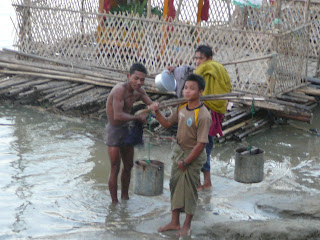
At 4pm, we stop at a small village called Ohn Ne Choung, and are free to wander round for an hour. There is no dock, and the ship merely pulls into the river bank and throws out a gang plank.

We cross it and climb the steep sandy bank to find the village. The houses are the usual two room affairs made of bamboo and rattan. Each has a large fenced area around it with either a pig, or an ox tethered in the yard, or the well to do have both, plus chickens. It’s a bit like having your car and dinner sitting in the garden. There are narrow lanes between the houses often lined with trees making it very picturesque. There are some wider roads to allow the ox and cart to travel through it. The ground is very fine dirt, almost sand like, and so everywhere is dusty. There are a few power lines and no running water or sewer pipes. All the water is taken from the river, which is filthy. There is a constant stream of people going down to the river to fetch water in two pails hanging from a bamboo pole strung across their neck.


Friday, June 19, 2009
Irrawaddy - Our Ship
We board a ship for a two night cruise down the Irrawaddy to Mandalay , the same journey that Rudyard Kipling made so famous in his poem, the Road to Mandalay . It is a wonderful feeling to be traveling in his footsteps and the ship we are on recreates the atmosphere perfectly.

We are traveling on the Pandaw 2, which is a copy of the original Pandaw , designed in 1948 expressly for travel on the Irrawaddy . It has a draft of only three and a half feet, and what is mind boggling about the original is that it was built in Scotland and actually sailed from there to Burma with this shallow draft. The ships have been redesigned for today’s traveler and are a wonderful mix of modern day comfort with colonial design. Al l the cabins and fixtures are made of teak, the furniture is rattan and there is an extensive sundeck with teak reclining chairs. Our cabin opens onto the deck and there are two rattan chairs outside our door for our private use.

There are only 24 cabins and the ship boasts a staff of 26. However on our cruise there are just 4 passengers including us, so we get over 6 staff each!

Navigating the Irrawaddy has always been extremely difficult, because of its perilous waterways. It is a shallow and extremely wide river, full of sandbanks. There are neither locks nor weirs to control the water level, as there are on other great rivers of the world. Nor are there charts, as the sands shift with such rapidity that they would be out of date before the ink was dry. Instead they rely on a pilot ship that goes in front and marks a safe channel with bamboo poles. But even this method is not perfect, as we discover on our first night. At one point we are sandwiched between two fast shifting sandbanks that cut off our passage. We have to turn round and find another route past them. Several times during our trip we have two crew members standing either side of the bow of the ship measuring the depth of the river with long bamboo poles. They continually call out the depth to the captain and at one point we were down to less than 5ft.

We are traveling on the Pandaw 2, which is a copy of the original Pandaw , designed in 1948 expressly for travel on the Irrawaddy . It has a draft of only three and a half feet, and what is mind boggling about the original is that it was built in Scotland and actually sailed from there to Burma with this shallow draft. The ships have been redesigned for today’s traveler and are a wonderful mix of modern day comfort with colonial design. Al l the cabins and fixtures are made of teak, the furniture is rattan and there is an extensive sundeck with teak reclining chairs. Our cabin opens onto the deck and there are two rattan chairs outside our door for our private use.

There are only 24 cabins and the ship boasts a staff of 26. However on our cruise there are just 4 passengers including us, so we get over 6 staff each!

Navigating the Irrawaddy has always been extremely difficult, because of its perilous waterways. It is a shallow and extremely wide river, full of sandbanks. There are neither locks nor weirs to control the water level, as there are on other great rivers of the world. Nor are there charts, as the sands shift with such rapidity that they would be out of date before the ink was dry. Instead they rely on a pilot ship that goes in front and marks a safe channel with bamboo poles. But even this method is not perfect, as we discover on our first night. At one point we are sandwiched between two fast shifting sandbanks that cut off our passage. We have to turn round and find another route past them. Several times during our trip we have two crew members standing either side of the bow of the ship measuring the depth of the river with long bamboo poles. They continually call out the depth to the captain and at one point we were down to less than 5ft.
Friday, April 10, 2009
Burma - The Problems of Owning A Vehicle
The government of Burma has banned the import of all cars for several years now. In a demonstration of misguided thinking that might even outdo George Bush’s skills of logic, the reason for this is that the roads are so bad, more cars would just make the roads worse. Cars have become fantastically expensive because of the scarcity of good vehicles and because the government has put a 40% tax on all car sales. Our driver's car would have cost 2 or 3 thousand dollars 6 years ago, but is now sell for $20,000.
The government has just announced that it will allow a few new cars to be imported, but they are only to be used as taxis and car hire vehicles.
This brings on yet another round of complaints about the government. All gas (petrol) is rationed. The cheapest motorbike on the market is Chinese. If you buy one of these with a license, you are allowed 4 gallons of gas a month. If you can afford the much better and much more expensive Japanese bike with a license you get 10 gallons a month. However if you get a bike on the black market with no license (much cheaper that way), then you get no gas. This of course has led to a thriving black market for gas to which the government turns a blind eye. Gas from the government costs $1.50 a gallon, but on the black market it costs twice as much. (It was the Generals putting up the price to $1.50 that started the recent troubles).
Cars are only allowed 8 gallons of gas a month, so now we know why there are so few cars on the road. A couple of years ago, the tourist industry gathered together and petitioned the government for more gas for the taxis that take the tourists around. The government agreed and allowed the taxis more gas. But this arrangement only lasted for one month. So the taxis are almost totally dependent on black market gas.
Most towns or cities only have a very few government gas stations, consequently the Burmese have to allow an hour of their time each week to line up for their ration of gas.
The government has just announced that it will allow a few new cars to be imported, but they are only to be used as taxis and car hire vehicles.
This brings on yet another round of complaints about the government. All gas (petrol) is rationed. The cheapest motorbike on the market is Chinese. If you buy one of these with a license, you are allowed 4 gallons of gas a month. If you can afford the much better and much more expensive Japanese bike with a license you get 10 gallons a month. However if you get a bike on the black market with no license (much cheaper that way), then you get no gas. This of course has led to a thriving black market for gas to which the government turns a blind eye. Gas from the government costs $1.50 a gallon, but on the black market it costs twice as much. (It was the Generals putting up the price to $1.50 that started the recent troubles).
Cars are only allowed 8 gallons of gas a month, so now we know why there are so few cars on the road. A couple of years ago, the tourist industry gathered together and petitioned the government for more gas for the taxis that take the tourists around. The government agreed and allowed the taxis more gas. But this arrangement only lasted for one month. So the taxis are almost totally dependent on black market gas.
Most towns or cities only have a very few government gas stations, consequently the Burmese have to allow an hour of their time each week to line up for their ration of gas.
Wednesday, April 8, 2009
Pindaya Caves - The Road There
We drive to Pindaya to see the famous caves filled with Buddhas. It is a 50 mile journey that takes 3 hours because of the appalling road. The road is in fact the main route to Yangon , but it is in terrible condition, only wide enough for one vehicle and full of potholes , with entire sections actually without a hard surface. Most of the roads were built by the British pre1948 and have not been touched since. Because this is a major route it is busy with buses and large trucks. It is impossible to pass anything unless you can persuade them, by continually blowing your horn, to move off the road. When a vehicle is coming the other way, one of you has to move on to the unmade verge. Consequently a lot of the drive involves playing the game of chicken.
A remarkable number of vehicles on the road are actually animal driven. They are either large carts piled high with produce being pulled by two oxen, or water buffalo, or a small passenger trap being driven by even smaller horses.


There are also a large number of bicycles, all of which look like antiques and are of the “sit up and beg” variety, with huge wheels. Other than that, the most common transport is a tractor straight out of the 1950’s, that has been converted into a small truck. The front part is still obviously the front of a small tractor while the back half has been transformed into a sort of flat bed truck, used for hauling produce or just as often, a large number of people.

There are very few regular cars, and those that we do see are, as before, old Toyotas from the 80’s. Our driver tells us that he bought his car used, fifteen years ago. When we comment that it has lasted well considering the road conditions, he gets quite agitated and says that it has to be repaired at least once a month. Cars are fantastically expensive to buy as they have a tax of 40% added on by the government, and to add insult to injury, we are stopped every 15 miles or so to pay a road toll.
A remarkable number of vehicles on the road are actually animal driven. They are either large carts piled high with produce being pulled by two oxen, or water buffalo, or a small passenger trap being driven by even smaller horses.


There are also a large number of bicycles, all of which look like antiques and are of the “sit up and beg” variety, with huge wheels. Other than that, the most common transport is a tractor straight out of the 1950’s, that has been converted into a small truck. The front part is still obviously the front of a small tractor while the back half has been transformed into a sort of flat bed truck, used for hauling produce or just as often, a large number of people.

There are very few regular cars, and those that we do see are, as before, old Toyotas from the 80’s. Our driver tells us that he bought his car used, fifteen years ago. When we comment that it has lasted well considering the road conditions, he gets quite agitated and says that it has to be repaired at least once a month. Cars are fantastically expensive to buy as they have a tax of 40% added on by the government, and to add insult to injury, we are stopped every 15 miles or so to pay a road toll.
Wednesday, April 1, 2009
Inle Lake - We Take Tea
 The house fills up rapidly with people, some family, some neighbours, all come to meet the foreigners. There is an eighty year old woman who lives next door, and several toddlers. They all sit in a big circle round us on the floor. Tea is made and offered. They are all charming and entertaining and interested in us, with a lively sense of humour. They want to know where our families are, and when we say we do not have families, they invite us to join theirs. Now, as I am sure you appreciate, there is absolutely no way on God’s Earth that this is going to happen, but I manage a gracious smile, and say that I would love to, as long as they didn’t expect me to row with one leg. There is much laughter. After a while one of the daughters disappears into the kitchen and returns some time later with the most delicious potato crisps we ever tasted. She has just made them over the open fire in their tiny kitchen. Considering the place is made of wood and reeds, the open fire seems a little dangerous and we ask if their houses ever catch fire. This is cause for a lot more laughter, even though the answer is yes.
We stay well over an hour and feel very comfortable. They are genuinely welcoming and we are touched by the whole experience, particularly when we leave and the father turns to me and says that he hopes we will be brothers in our next life. They are the poorest people we are ever likely to meet, but their quality of life appears rich indeed.

After further visits to a floating farm and a weaving business, we return to our hotel for dinner. There is a card on the table advertising tonight’s special appetizer, which is mussels cooked in butter and garlic. We point to that assuming the waiters must know about it. We do get them, but unfortunately they arrive about 30 minutes after the main course. There are a total of six mussels on a plate and are served with profuse apologies from the head waiter and little else.
Monday, March 30, 2009
Inle Lake - We Visit A Home
The next village we visit on Inle Lake is a fishing village, and actually in the lake, rather than along the waters edge like the last two. The streets of this village are waterways with rows of stilt houses on either side.

Some have little floating gardens, and hedges, others have pots with plants in them on a platform. All have small landing jetties for their boats. It is from one of these jetties that we are greeted by a mother and young daughter. They wave as we go by, and the driver takes the boat over to them and we start to speak to them through our guide. We are invited into their house and we readily accept. We go up the steps from the jetty into the usual two room affair with no furniture other than two old wicker chairs kept for important guests, which in this case turns out to be us. Everyone else sleeps, sits and eats on the floor. Is this why everyone takes their shoes off when entering a house, because basically you are walking on their dining table?
We learn that the parents have 14 children, presumably a result of living in the middle of a lake where there is little in the way of evening entertainment.

The parents sleep in one room and all the children sleep in the other, which is their main living room. No one leaves home until they get married. There is a small kitchen off the back, and a bamboo bridge to a separate “privy”. The privy has a modern style toilet, but no plumbing. It just sits over a hole in the floor and empties into the lake. There are 16 people living in this house, using this toilet, and it is just one of hundreds of similar houses. Suddenly we are not so hungry for fresh fish from the lake.

Some have little floating gardens, and hedges, others have pots with plants in them on a platform. All have small landing jetties for their boats. It is from one of these jetties that we are greeted by a mother and young daughter. They wave as we go by, and the driver takes the boat over to them and we start to speak to them through our guide. We are invited into their house and we readily accept. We go up the steps from the jetty into the usual two room affair with no furniture other than two old wicker chairs kept for important guests, which in this case turns out to be us. Everyone else sleeps, sits and eats on the floor. Is this why everyone takes their shoes off when entering a house, because basically you are walking on their dining table?
We learn that the parents have 14 children, presumably a result of living in the middle of a lake where there is little in the way of evening entertainment.

The parents sleep in one room and all the children sleep in the other, which is their main living room. No one leaves home until they get married. There is a small kitchen off the back, and a bamboo bridge to a separate “privy”. The privy has a modern style toilet, but no plumbing. It just sits over a hole in the floor and empties into the lake. There are 16 people living in this house, using this toilet, and it is just one of hundreds of similar houses. Suddenly we are not so hungry for fresh fish from the lake.
Friday, March 27, 2009
Inle Lake - A Day
We have heard that Inle lake is severely over fished, with catches getting smaller and smaller and as we set out to explore the lake it is immediately obvious why. The lake is covered with small boats each with a man fishing. They are in boats very similar to ours but a little shorter and without an engine.

Some drive fish towards nets by beating the water with long poles. Others stand on the small platform at the front, and wrap their leg around a long oar. Using a combined twisting of their body and circling motion of their leg they can propel the boat, and make girls hearts flutter on the dance floor. On the boat it leaves both hands free to fish, which they do with a fishing line, a net, or a huge cone shaped bamboo “beehive”.

These are the famous fishermen of Inle Lake and it is fascinating to watch them. Many of them are friendly and come along side our boat so that we can take pictures and exchange smiles of greeting.

We pay our first visit to a village where we meet the Pao tribe. The women wear all black with a colourful headdress, which actually looks like a small blanket folded neatly on top of their head, which must come in handy as it gets quite cold at night. You can tell which village they come from by the colour of this blanket. We go to see one of their markets, which is a desultory affair, with desperately poor looking women trying to sell tiny amounts of vegetables or spices.

Many of the women are smoking large fat cigars. We are not sure what is in the cigars, but they certainly seem happier than their immediate surroundings would warrant.

From here we go along the lake to the next village to see the Paduang tribe, famous for their long necked women.

The women wear gold coloured metal coils around their necks and calves. It gives the women very long necks, but apparently doesn’t actually stretch the neck, rather it pushes down the collar bone. They can take the coils off, but have to be extremely careful for three weeks until their collar bone recovers its original position. The origin of this is to protect from tigers, which always attack either the legs or the neck. There are only a handful of these women left, not because all the others have been killed by tigers, but because the majority of the tribe crossed the border to Thailand where they can make much more money from the tourist industry.

Some drive fish towards nets by beating the water with long poles. Others stand on the small platform at the front, and wrap their leg around a long oar. Using a combined twisting of their body and circling motion of their leg they can propel the boat, and make girls hearts flutter on the dance floor. On the boat it leaves both hands free to fish, which they do with a fishing line, a net, or a huge cone shaped bamboo “beehive”.

These are the famous fishermen of Inle Lake and it is fascinating to watch them. Many of them are friendly and come along side our boat so that we can take pictures and exchange smiles of greeting.

We pay our first visit to a village where we meet the Pao tribe. The women wear all black with a colourful headdress, which actually looks like a small blanket folded neatly on top of their head, which must come in handy as it gets quite cold at night. You can tell which village they come from by the colour of this blanket. We go to see one of their markets, which is a desultory affair, with desperately poor looking women trying to sell tiny amounts of vegetables or spices.

Many of the women are smoking large fat cigars. We are not sure what is in the cigars, but they certainly seem happier than their immediate surroundings would warrant.

From here we go along the lake to the next village to see the Paduang tribe, famous for their long necked women.

The women wear gold coloured metal coils around their necks and calves. It gives the women very long necks, but apparently doesn’t actually stretch the neck, rather it pushes down the collar bone. They can take the coils off, but have to be extremely careful for three weeks until their collar bone recovers its original position. The origin of this is to protect from tigers, which always attack either the legs or the neck. There are only a handful of these women left, not because all the others have been killed by tigers, but because the majority of the tribe crossed the border to Thailand where they can make much more money from the tourist industry.
Wednesday, March 25, 2009
Inle Lake - Transportation
We are to spend the next two days on Inle Lake exploring all the villages and the life of the locals. The lake is about 15 miles long and anything from a few hundred yards to a mile or so wide. 125,000 people inhabit its shores, mainly living in small villages built on stilts above the water.

The houses are simple two room affairs built of bamboo and reeds. They last ten years before they fall apart, and then the entire village gets together to build a replacement. The people either fish or farm, and their method of doing both is part of the reason we have come here.
Our hotel has a jetty leading out to a small inlet and it is here we find our transport for the next two days. The boat is shaped like a dugout canoe, only much longer. It must be twenty five feet long and little more than 2ft 6 wide. It has an extremely shallow draught, because the lake itself is often a little more than a couple of feet deep. The front rises up out of the water, and the back end has what looks like an old lawn mower engine sitting on a platform with an eight foot metal rod running directly from it to a small propeller. In this way the driver can make sure the propeller just skims the surface of the water and doesn’t hit the bottom or get caught in weeds.
There are three wooden arm chairs for the tourists. Each chair comes with a rather worn cushion, and an umbrella. We are told the boat is extremely unstable because of its shallow draft, so we must step directly into the middle of the boat, and not on to the sides.

Once we take our seats, the driver starts the engine which coughs and sputters a few times and then lets out a high pitch wine. The boat shoots forward like a bat out of hell. The smallest turn causes it to lean to one side in the most alarming fashion. Conversation with the person behind you is almost impossible because of, one, the noise of the engine, and two, the act of turning round causes the boat to wobble. Strangely enough, just as an ocean going liner attracts a flock of seagulls following it, so does this small rocket boat.


The houses are simple two room affairs built of bamboo and reeds. They last ten years before they fall apart, and then the entire village gets together to build a replacement. The people either fish or farm, and their method of doing both is part of the reason we have come here.
Our hotel has a jetty leading out to a small inlet and it is here we find our transport for the next two days. The boat is shaped like a dugout canoe, only much longer. It must be twenty five feet long and little more than 2ft 6 wide. It has an extremely shallow draught, because the lake itself is often a little more than a couple of feet deep. The front rises up out of the water, and the back end has what looks like an old lawn mower engine sitting on a platform with an eight foot metal rod running directly from it to a small propeller. In this way the driver can make sure the propeller just skims the surface of the water and doesn’t hit the bottom or get caught in weeds.
There are three wooden arm chairs for the tourists. Each chair comes with a rather worn cushion, and an umbrella. We are told the boat is extremely unstable because of its shallow draft, so we must step directly into the middle of the boat, and not on to the sides.

Once we take our seats, the driver starts the engine which coughs and sputters a few times and then lets out a high pitch wine. The boat shoots forward like a bat out of hell. The smallest turn causes it to lean to one side in the most alarming fashion. Conversation with the person behind you is almost impossible because of, one, the noise of the engine, and two, the act of turning round causes the boat to wobble. Strangely enough, just as an ocean going liner attracts a flock of seagulls following it, so does this small rocket boat.

Wednesday, March 18, 2009
Yangon - To Inle Lake
Yangon was a rather sad start to our trip, and we were beginning to wish we had listened to some of our friends who said what the hell were we thinking of, going to Myanmar. However things pick up considerably from here, and we have what turns out to be a fascinating trip. The country is almost entirely devoid of tourists and we often feel we are the only two in town!
We stay in some wonderful hotels which are virtually deserted, we eat in upscale restaurants often without other diners, we visit wonderful sites and have them to ourselves, we take a river cruise on a ship designed to carry 48 people and find just two other people on board. It is a poignant comment on the tyranny of the Burmese government. The Burmese people live with an underlying current of unbelievable political repression, but somehow, while they suffer horrendous hardships, they still keep smiling. They are a wonderful and graceful people and they welcome us everywhere we go.
From Yangon, we fly to Heho, a name that seems destined to be turned into a joke. But all thoughts of humour are thrown out of the window by a rather stern looking woman who meets us at the airport, and tells us that her name is Rosa. We try hard not to think of Rosa Klebb, from an early James Bond movie. She is to be our guide for the next four days, an altogether daunting thought. She is the complete antithesis to Paris.
We offer her what we hope is a winning smile, and settle into what proves to be a very interesting few days.
We drive to Inle Lake , which is to be our destination for the next three nights. Inle Lake is a large and very beautiful lake that is not always on the main tourist route. It is an hour’s drive from Heho. Rosa soon warms up and we discover she is a fascinating and intelligent woman who is completely open in her discussion of, and disgust for, the current regime. She starts by telling us that part of the road we will be driving on is in excellent condition, and part of the road is very poor. She also explains that part of the road is privately owned, while part of the road is owned by the government. When Gordon surmises that the good road is the government road, she laughs derisively, and tells him he is wrong. In fact the first part of the road is privately owned and is a two lane road in good condition. Just as the road deteriorates into a single uneven lane full of potholes and no sidewalk, we are stopped and have to pay a toll to travel any further. It is amazing what payment of a few dollars to the government can fail to do.
We stay in some wonderful hotels which are virtually deserted, we eat in upscale restaurants often without other diners, we visit wonderful sites and have them to ourselves, we take a river cruise on a ship designed to carry 48 people and find just two other people on board. It is a poignant comment on the tyranny of the Burmese government. The Burmese people live with an underlying current of unbelievable political repression, but somehow, while they suffer horrendous hardships, they still keep smiling. They are a wonderful and graceful people and they welcome us everywhere we go.
From Yangon, we fly to Heho, a name that seems destined to be turned into a joke. But all thoughts of humour are thrown out of the window by a rather stern looking woman who meets us at the airport, and tells us that her name is Rosa. We try hard not to think of Rosa Klebb, from an early James Bond movie. She is to be our guide for the next four days, an altogether daunting thought. She is the complete antithesis to Paris.
We offer her what we hope is a winning smile, and settle into what proves to be a very interesting few days.
We drive to Inle Lake , which is to be our destination for the next three nights. Inle Lake is a large and very beautiful lake that is not always on the main tourist route. It is an hour’s drive from Heho. Rosa soon warms up and we discover she is a fascinating and intelligent woman who is completely open in her discussion of, and disgust for, the current regime. She starts by telling us that part of the road we will be driving on is in excellent condition, and part of the road is very poor. She also explains that part of the road is privately owned, while part of the road is owned by the government. When Gordon surmises that the good road is the government road, she laughs derisively, and tells him he is wrong. In fact the first part of the road is privately owned and is a two lane road in good condition. Just as the road deteriorates into a single uneven lane full of potholes and no sidewalk, we are stopped and have to pay a toll to travel any further. It is amazing what payment of a few dollars to the government can fail to do.
Friday, March 6, 2009
Yangon - the British Legacy
Yangon was a very British City in the late 19th and early 20th centuries. But the British left in 1948, and they took with them their grandiose dreams of a great city. Their legacy is in ruins. The boulevards they laid out are now full of potholes, and crumbling sidewalks. The few street lights that still work are dark because there is not enough power to operate them. The magnificent automobiles of the thirties and forties have been replaced by dilapidated Toyotas from the 70’s and early 80’s. There are no new, or even vaguely new, cars. As a final insult to the British, the fine British tradition of driving on the left was revoked in 1972, when the Burmese government announced that the entire country had 7 days to learn to drive on the right. But no one thought to tell Toyota, so all the cars still have the steering wheels on the right.
In a strange twist on Asian transport, there are no motorbikes. The government banned them because of the number of accidents. But they are only banned in Yangon . Presumably it is acceptable to die on a motorbike anywhere else in Myanmar. Because there are no motorbikes, everyone travels by bus. There are hundreds of buses, but they are even older than the cars, many of them strange little toy like vehicles imported from England in the 1940’s.

They are small, dirty, without air conditioning, and crammed full of people, just like in Britain, but more so. This however is the luxury form of transport. They also have small Toyota pick up trucks from the 70’s that serve as buses. They have a shell roof on the back without sides, and narrow seats running the length of the truck bed on either side. About 12 people can cram themselves onto the seats. Another 10 can sit on the roof, and half a dozen hang perilously off the back. The price is no cheaper for the pick up truck than for the buses, but they have no sides so they are cooler and often more popular. The cheapest form of transport is the train, but no one uses it unless they have to, as they are unbelievably slow and notoriously unreliable. Some British traditions couldn’t be shaken.
In a strange twist on Asian transport, there are no motorbikes. The government banned them because of the number of accidents. But they are only banned in Yangon . Presumably it is acceptable to die on a motorbike anywhere else in Myanmar. Because there are no motorbikes, everyone travels by bus. There are hundreds of buses, but they are even older than the cars, many of them strange little toy like vehicles imported from England in the 1940’s.

They are small, dirty, without air conditioning, and crammed full of people, just like in Britain, but more so. This however is the luxury form of transport. They also have small Toyota pick up trucks from the 70’s that serve as buses. They have a shell roof on the back without sides, and narrow seats running the length of the truck bed on either side. About 12 people can cram themselves onto the seats. Another 10 can sit on the roof, and half a dozen hang perilously off the back. The price is no cheaper for the pick up truck than for the buses, but they have no sides so they are cooler and often more popular. The cheapest form of transport is the train, but no one uses it unless they have to, as they are unbelievably slow and notoriously unreliable. Some British traditions couldn’t be shaken.
Subscribe to:
Posts (Atom)
