We spend several months a year in Puerto Vallarta and love it. In fact we love it so much we have never left it to explore the rest of the country. But today we are finally doing something about that. We are flying to Mexico City for three days to start off a 15 day trip to the east of the country.
We are doing all our flights on Aviacsa Airlines, one of Mexico’s new low cost airlines, and are impressed by the clean new planes, the ample leg room and the efficient service.
We have heard horror stories about Mexico City’s huge airport, and expect the worst. But we are pleasantly surprised. Admittedly we arrive at the domestic terminal, and not the International one, but we are off the plane and into a taxi, with our luggage in hand all in the space of 15 minutes.
The taxis too are a vast improvement on the ones we are used to in Puerto Vallarta. These are new, clean and metered. The driver is wearing an elegantly pressed white shirt and tie with a rather natty waistcoat.
We are staying in the Zona Rosa, which everyone tells us is a lively and safe neighborhood close to the City center. It is one of the city's most touristy areas, filled with hotels, dance clubs, restaurants, bars and live music. Zona Rosa means “the Pink Area” which is appropriate as it is home to a large gay population. Our hotel is on Londres Street which no one told us was THE gay street. It is packed with mainly young gay men. Mexico City has passed a law allowing gay unions, an extremely advanced action for a Catholic country. The young gays in the area are definitely out and proud, many holding hands as they walk along the street.
We are amused to see that the latest street fashion for these young men is extremely tight jeans often paired with white Go Go boots. Their main accessory is hair gel, which they appear to ladle on with a trowel.
We are staying at the EuroStars Zona Rosa Suites Hotel, which was obviously a very hip hotel in its day, but its day passed several years ago and now it is comfortable but fading.
Showing posts with label adventure. Show all posts
Showing posts with label adventure. Show all posts
Monday, August 31, 2009


Friday, August 14, 2009
Burma - Our Final Thoughts
This is our final night in Myanmar and it is tinged with regret. We have made friends with some of our guides and their memory will stay with us for many years. We could travel the world and never come across another character like Paris. We would enjoy having a boy named Sue as a friend and it was a privilege to meet Rosa.
The Burmese people are delightful, the country beautiful and some of the antiquities are breathtaking. But an underlying feeling of sadness and anger has been with us through the entire trip. We have never seen so much needless suffering. There are millions of people in Africa who are probably worse off, but often the reason for that is the total lack of resources, food and water. But here the country is rich in all of those things, but the Junta controls everything, and the generals are the only people allowed to benefit. Even if the status quo wasn’t changed, the people could be benefiting from the wealth that a popular tourist destination could bring them. The country could easily be as popular a destination as Thailand , Vietnam or Cambodia . But the Junta is hostile to the prying eyes of outside countries, and many tourists who suffer our doubts about patronizing the country decide to stay away.
The Junta controls the people, holding them back, and holding them down, denying them education, denying them the benefits of a rich country, denying them the spoils of tourism, and basically denying them a comfortable life. It is hard to really enjoy a vacation in this wonderful country, when this is the undercurrent. But so many of the people thanked us for coming, and asked us to come back, that we are happy that we went, and determined to return.

The Burmese people are delightful, the country beautiful and some of the antiquities are breathtaking. But an underlying feeling of sadness and anger has been with us through the entire trip. We have never seen so much needless suffering. There are millions of people in Africa who are probably worse off, but often the reason for that is the total lack of resources, food and water. But here the country is rich in all of those things, but the Junta controls everything, and the generals are the only people allowed to benefit. Even if the status quo wasn’t changed, the people could be benefiting from the wealth that a popular tourist destination could bring them. The country could easily be as popular a destination as Thailand , Vietnam or Cambodia . But the Junta is hostile to the prying eyes of outside countries, and many tourists who suffer our doubts about patronizing the country decide to stay away.
The Junta controls the people, holding them back, and holding them down, denying them education, denying them the benefits of a rich country, denying them the spoils of tourism, and basically denying them a comfortable life. It is hard to really enjoy a vacation in this wonderful country, when this is the undercurrent. But so many of the people thanked us for coming, and asked us to come back, that we are happy that we went, and determined to return.

Monday, August 3, 2009
The Village of Nowohen
We walk down into a valley and up the other side to reach the village of Nowohen where the Akha tribe lives. They also wear black clothing, but this time the women have magnificent silver headdresses, rows of beaded necklaces and beaded belts and bags. The headdresses are made of real silver and have been handed down from mother to daughter. However many of the younger women have given up wearing them because they are so uncomfortable. This, combined with the fact that tourists will pay $500 for one headdress, means that within a few years it may no longer be possible to see this tribe in their original clothing.


This village is quite clearly far more prosperous than the last one, with the 26 houses laid out along two dirt streets, and small corrals with goats, chickens and pigs.

The homes are larger, and better constructed, although still just made of bamboo and matting. We are grateful to see that everyone looks clean, at least when compared to the last village. It turns out that the success of this village is almost entirely due to the fact that a missionary came here 14 years ago, and has taught the village basic principals of hygiene, village planning and husbandry. The entire village has converted to Catholicism. This originally caused some problems as prior to the Missionary’s arrival a tribesman was allowed two wives if he could afford them. In an example of true wisdom seldom seen in the church, the Missionary has told the people that this is fine, and that the arrangement can continue as long as the two wives were acquired before they became Christian.
In this village the wife has a separate bedroom from the husband, and if the husband desires sex, he must knock on her bedroom door first and be invited in. We might be centuries ahead of them in many ways, but we still could learn something from this tribe!


This village is quite clearly far more prosperous than the last one, with the 26 houses laid out along two dirt streets, and small corrals with goats, chickens and pigs.

The homes are larger, and better constructed, although still just made of bamboo and matting. We are grateful to see that everyone looks clean, at least when compared to the last village. It turns out that the success of this village is almost entirely due to the fact that a missionary came here 14 years ago, and has taught the village basic principals of hygiene, village planning and husbandry. The entire village has converted to Catholicism. This originally caused some problems as prior to the Missionary’s arrival a tribesman was allowed two wives if he could afford them. In an example of true wisdom seldom seen in the church, the Missionary has told the people that this is fine, and that the arrangement can continue as long as the two wives were acquired before they became Christian.
In this village the wife has a separate bedroom from the husband, and if the husband desires sex, he must knock on her bedroom door first and be invited in. We might be centuries ahead of them in many ways, but we still could learn something from this tribe!
Monday, April 6, 2009
Inle Lake - Our Guide's Further Thoughts
Indien, with its 1090 stuppas, is a wonderful place with a spiritual peacefulness that makes it feel quite special. The views of the surrounding countryside are lovely, and yet we are the only tourists there all afternoon. This leads to another long and frank discussion with our guide about the state of Myanmar. She explains how the poor people in Myanmar are not concerned with politics. Buddhists believe that what happens to them in this life is a direct result of what they did in their past life. If times are extremely hard in this life, they accept it. They do not blame the current regime for their misfortune. Our guide tells us that when the crackdown occurred she was actually traveling in the country, and she asked a woman she met, if she knew of what was happening in Yangon. The woman didn’t. And when the guide started to tell her that monks had been shot, the woman said “Don’t talk to me about politics, it doesn’t concern me”. It is only the educated who come to recognize the repercussions of the current regime’s behaviour. The regime therefore makes sure that the schools are poor, and education past elementary is expensive, thus insuring that the people remain uneducated, uncomplaining and uninterested. This is why most uprisings start with the educated.
She also tells us a fact that the Government does not want outsiders to know. The electricity for the country comes from one Hydro Electric Dam built at the end of Lake Inle by the Japanese in the early 60s. Over the years the level of the lake has dropped as village construction increases and silt builds up against the dam. This has severely impacted the output of the dam turbines. The entire country now only gets full power for 3 days a week, and for 6 hours a day on the other four days. All the major hotels and tourist restaurants have generators.
Another points she tells us is that the average Myanmar citizen, no matter how poor, donates around 40% of their earnings to the temples, thus showing how important religion is to them.

She also discusses the influence of the Chinese on her country. There are many Chinese in Myanmar , and particularly in this area, because of the closeness of the border. Rosa explains that the Chinese are very smart business people, and that all the businesses are owned by Chinese, while all the work is done by the Burmese. All the guides we have throughout our stay in Myanmar, are united in their dislike of the Chinese. Not only does China plunder the resources of Myanmar without a thought for the people, but a large proportion of the 300,000 tourists Burma gets each year are Chinese, and the guides say that the Chinese are rude and pushy tourists unwilling to pay much money for anything.
She also tells us a fact that the Government does not want outsiders to know. The electricity for the country comes from one Hydro Electric Dam built at the end of Lake Inle by the Japanese in the early 60s. Over the years the level of the lake has dropped as village construction increases and silt builds up against the dam. This has severely impacted the output of the dam turbines. The entire country now only gets full power for 3 days a week, and for 6 hours a day on the other four days. All the major hotels and tourist restaurants have generators.
Another points she tells us is that the average Myanmar citizen, no matter how poor, donates around 40% of their earnings to the temples, thus showing how important religion is to them.

She also discusses the influence of the Chinese on her country. There are many Chinese in Myanmar , and particularly in this area, because of the closeness of the border. Rosa explains that the Chinese are very smart business people, and that all the businesses are owned by Chinese, while all the work is done by the Burmese. All the guides we have throughout our stay in Myanmar, are united in their dislike of the Chinese. Not only does China plunder the resources of Myanmar without a thought for the people, but a large proportion of the 300,000 tourists Burma gets each year are Chinese, and the guides say that the Chinese are rude and pushy tourists unwilling to pay much money for anything.
Friday, April 3, 2009
Inle Lake - A Second Day
By 9am we are back on the hard little seats in the long narrow boat. Having learned our lesson yesterday, we have had virtually nothing to drink for breakfast. There are no toilets on the boat or anywhere round the lake, and yesterday we sat for hours with our legs held tightly together. We couldn’t even jiggle around in our discomfort for fear of upsetting the boat.
We start the day at another market, this one is much bigger and feels more prosperous, but that is just in comparison to yesterday. There is an adjoining fish market where all sorts of different fish are laid out on the ground. They are all pitifully small. The vendors get a much better price for the fish if they are still alive, so they go to great lengths to insure that they are. Bunches of about 8 or 10 are held together by a thread running through their gills, and each bunch is periodically dipped in a bowl of water to revive them. Once they start flapping around in the water they are promptly removed and laid out on the ground for inspection.


From here, we go up a small river leading off the lake for about 20 minutes until we arrive at the small town of Indein. It is here that we find a hillside that is covered in 1090 stuppas, all built in the 17th century and all in a sad state of disrepair. It is a magnificent sight, but the stuppas are crumbling, have trees growing through them and are overgrown by the surrounding jungle. Our guide explains that the Myanmar people consider it extremely bad luck to do anything to the stuppas, and so they are just left to crumble. Some of the more concerned citizens have asked the local tribal chiefs if they couldn’t at least keep the jungle at bay and cut the trees that are doing damage, but so far with no results.


There are two kinds of stuppas, one is solid but the other has an entrance and is hollow inside. These hollow stuppas each had a Buddha inside them, but now almost all of them are empty. Antique dealers from Thailand come over and pillage the Buddhas to sell in their stores back home.
We start the day at another market, this one is much bigger and feels more prosperous, but that is just in comparison to yesterday. There is an adjoining fish market where all sorts of different fish are laid out on the ground. They are all pitifully small. The vendors get a much better price for the fish if they are still alive, so they go to great lengths to insure that they are. Bunches of about 8 or 10 are held together by a thread running through their gills, and each bunch is periodically dipped in a bowl of water to revive them. Once they start flapping around in the water they are promptly removed and laid out on the ground for inspection.


From here, we go up a small river leading off the lake for about 20 minutes until we arrive at the small town of Indein. It is here that we find a hillside that is covered in 1090 stuppas, all built in the 17th century and all in a sad state of disrepair. It is a magnificent sight, but the stuppas are crumbling, have trees growing through them and are overgrown by the surrounding jungle. Our guide explains that the Myanmar people consider it extremely bad luck to do anything to the stuppas, and so they are just left to crumble. Some of the more concerned citizens have asked the local tribal chiefs if they couldn’t at least keep the jungle at bay and cut the trees that are doing damage, but so far with no results.


There are two kinds of stuppas, one is solid but the other has an entrance and is hollow inside. These hollow stuppas each had a Buddha inside them, but now almost all of them are empty. Antique dealers from Thailand come over and pillage the Buddhas to sell in their stores back home.
Wednesday, April 1, 2009
Inle Lake - We Take Tea
 The house fills up rapidly with people, some family, some neighbours, all come to meet the foreigners. There is an eighty year old woman who lives next door, and several toddlers. They all sit in a big circle round us on the floor. Tea is made and offered. They are all charming and entertaining and interested in us, with a lively sense of humour. They want to know where our families are, and when we say we do not have families, they invite us to join theirs. Now, as I am sure you appreciate, there is absolutely no way on God’s Earth that this is going to happen, but I manage a gracious smile, and say that I would love to, as long as they didn’t expect me to row with one leg. There is much laughter. After a while one of the daughters disappears into the kitchen and returns some time later with the most delicious potato crisps we ever tasted. She has just made them over the open fire in their tiny kitchen. Considering the place is made of wood and reeds, the open fire seems a little dangerous and we ask if their houses ever catch fire. This is cause for a lot more laughter, even though the answer is yes.
We stay well over an hour and feel very comfortable. They are genuinely welcoming and we are touched by the whole experience, particularly when we leave and the father turns to me and says that he hopes we will be brothers in our next life. They are the poorest people we are ever likely to meet, but their quality of life appears rich indeed.

After further visits to a floating farm and a weaving business, we return to our hotel for dinner. There is a card on the table advertising tonight’s special appetizer, which is mussels cooked in butter and garlic. We point to that assuming the waiters must know about it. We do get them, but unfortunately they arrive about 30 minutes after the main course. There are a total of six mussels on a plate and are served with profuse apologies from the head waiter and little else.
Monday, March 30, 2009
Inle Lake - We Visit A Home
The next village we visit on Inle Lake is a fishing village, and actually in the lake, rather than along the waters edge like the last two. The streets of this village are waterways with rows of stilt houses on either side.

Some have little floating gardens, and hedges, others have pots with plants in them on a platform. All have small landing jetties for their boats. It is from one of these jetties that we are greeted by a mother and young daughter. They wave as we go by, and the driver takes the boat over to them and we start to speak to them through our guide. We are invited into their house and we readily accept. We go up the steps from the jetty into the usual two room affair with no furniture other than two old wicker chairs kept for important guests, which in this case turns out to be us. Everyone else sleeps, sits and eats on the floor. Is this why everyone takes their shoes off when entering a house, because basically you are walking on their dining table?
We learn that the parents have 14 children, presumably a result of living in the middle of a lake where there is little in the way of evening entertainment.

The parents sleep in one room and all the children sleep in the other, which is their main living room. No one leaves home until they get married. There is a small kitchen off the back, and a bamboo bridge to a separate “privy”. The privy has a modern style toilet, but no plumbing. It just sits over a hole in the floor and empties into the lake. There are 16 people living in this house, using this toilet, and it is just one of hundreds of similar houses. Suddenly we are not so hungry for fresh fish from the lake.

Some have little floating gardens, and hedges, others have pots with plants in them on a platform. All have small landing jetties for their boats. It is from one of these jetties that we are greeted by a mother and young daughter. They wave as we go by, and the driver takes the boat over to them and we start to speak to them through our guide. We are invited into their house and we readily accept. We go up the steps from the jetty into the usual two room affair with no furniture other than two old wicker chairs kept for important guests, which in this case turns out to be us. Everyone else sleeps, sits and eats on the floor. Is this why everyone takes their shoes off when entering a house, because basically you are walking on their dining table?
We learn that the parents have 14 children, presumably a result of living in the middle of a lake where there is little in the way of evening entertainment.

The parents sleep in one room and all the children sleep in the other, which is their main living room. No one leaves home until they get married. There is a small kitchen off the back, and a bamboo bridge to a separate “privy”. The privy has a modern style toilet, but no plumbing. It just sits over a hole in the floor and empties into the lake. There are 16 people living in this house, using this toilet, and it is just one of hundreds of similar houses. Suddenly we are not so hungry for fresh fish from the lake.
Friday, March 27, 2009
Inle Lake - A Day
We have heard that Inle lake is severely over fished, with catches getting smaller and smaller and as we set out to explore the lake it is immediately obvious why. The lake is covered with small boats each with a man fishing. They are in boats very similar to ours but a little shorter and without an engine.

Some drive fish towards nets by beating the water with long poles. Others stand on the small platform at the front, and wrap their leg around a long oar. Using a combined twisting of their body and circling motion of their leg they can propel the boat, and make girls hearts flutter on the dance floor. On the boat it leaves both hands free to fish, which they do with a fishing line, a net, or a huge cone shaped bamboo “beehive”.

These are the famous fishermen of Inle Lake and it is fascinating to watch them. Many of them are friendly and come along side our boat so that we can take pictures and exchange smiles of greeting.

We pay our first visit to a village where we meet the Pao tribe. The women wear all black with a colourful headdress, which actually looks like a small blanket folded neatly on top of their head, which must come in handy as it gets quite cold at night. You can tell which village they come from by the colour of this blanket. We go to see one of their markets, which is a desultory affair, with desperately poor looking women trying to sell tiny amounts of vegetables or spices.

Many of the women are smoking large fat cigars. We are not sure what is in the cigars, but they certainly seem happier than their immediate surroundings would warrant.

From here we go along the lake to the next village to see the Paduang tribe, famous for their long necked women.

The women wear gold coloured metal coils around their necks and calves. It gives the women very long necks, but apparently doesn’t actually stretch the neck, rather it pushes down the collar bone. They can take the coils off, but have to be extremely careful for three weeks until their collar bone recovers its original position. The origin of this is to protect from tigers, which always attack either the legs or the neck. There are only a handful of these women left, not because all the others have been killed by tigers, but because the majority of the tribe crossed the border to Thailand where they can make much more money from the tourist industry.

Some drive fish towards nets by beating the water with long poles. Others stand on the small platform at the front, and wrap their leg around a long oar. Using a combined twisting of their body and circling motion of their leg they can propel the boat, and make girls hearts flutter on the dance floor. On the boat it leaves both hands free to fish, which they do with a fishing line, a net, or a huge cone shaped bamboo “beehive”.

These are the famous fishermen of Inle Lake and it is fascinating to watch them. Many of them are friendly and come along side our boat so that we can take pictures and exchange smiles of greeting.

We pay our first visit to a village where we meet the Pao tribe. The women wear all black with a colourful headdress, which actually looks like a small blanket folded neatly on top of their head, which must come in handy as it gets quite cold at night. You can tell which village they come from by the colour of this blanket. We go to see one of their markets, which is a desultory affair, with desperately poor looking women trying to sell tiny amounts of vegetables or spices.

Many of the women are smoking large fat cigars. We are not sure what is in the cigars, but they certainly seem happier than their immediate surroundings would warrant.

From here we go along the lake to the next village to see the Paduang tribe, famous for their long necked women.

The women wear gold coloured metal coils around their necks and calves. It gives the women very long necks, but apparently doesn’t actually stretch the neck, rather it pushes down the collar bone. They can take the coils off, but have to be extremely careful for three weeks until their collar bone recovers its original position. The origin of this is to protect from tigers, which always attack either the legs or the neck. There are only a handful of these women left, not because all the others have been killed by tigers, but because the majority of the tribe crossed the border to Thailand where they can make much more money from the tourist industry.
Wednesday, March 25, 2009
Inle Lake - Transportation
We are to spend the next two days on Inle Lake exploring all the villages and the life of the locals. The lake is about 15 miles long and anything from a few hundred yards to a mile or so wide. 125,000 people inhabit its shores, mainly living in small villages built on stilts above the water.

The houses are simple two room affairs built of bamboo and reeds. They last ten years before they fall apart, and then the entire village gets together to build a replacement. The people either fish or farm, and their method of doing both is part of the reason we have come here.
Our hotel has a jetty leading out to a small inlet and it is here we find our transport for the next two days. The boat is shaped like a dugout canoe, only much longer. It must be twenty five feet long and little more than 2ft 6 wide. It has an extremely shallow draught, because the lake itself is often a little more than a couple of feet deep. The front rises up out of the water, and the back end has what looks like an old lawn mower engine sitting on a platform with an eight foot metal rod running directly from it to a small propeller. In this way the driver can make sure the propeller just skims the surface of the water and doesn’t hit the bottom or get caught in weeds.
There are three wooden arm chairs for the tourists. Each chair comes with a rather worn cushion, and an umbrella. We are told the boat is extremely unstable because of its shallow draft, so we must step directly into the middle of the boat, and not on to the sides.

Once we take our seats, the driver starts the engine which coughs and sputters a few times and then lets out a high pitch wine. The boat shoots forward like a bat out of hell. The smallest turn causes it to lean to one side in the most alarming fashion. Conversation with the person behind you is almost impossible because of, one, the noise of the engine, and two, the act of turning round causes the boat to wobble. Strangely enough, just as an ocean going liner attracts a flock of seagulls following it, so does this small rocket boat.


The houses are simple two room affairs built of bamboo and reeds. They last ten years before they fall apart, and then the entire village gets together to build a replacement. The people either fish or farm, and their method of doing both is part of the reason we have come here.
Our hotel has a jetty leading out to a small inlet and it is here we find our transport for the next two days. The boat is shaped like a dugout canoe, only much longer. It must be twenty five feet long and little more than 2ft 6 wide. It has an extremely shallow draught, because the lake itself is often a little more than a couple of feet deep. The front rises up out of the water, and the back end has what looks like an old lawn mower engine sitting on a platform with an eight foot metal rod running directly from it to a small propeller. In this way the driver can make sure the propeller just skims the surface of the water and doesn’t hit the bottom or get caught in weeds.
There are three wooden arm chairs for the tourists. Each chair comes with a rather worn cushion, and an umbrella. We are told the boat is extremely unstable because of its shallow draft, so we must step directly into the middle of the boat, and not on to the sides.

Once we take our seats, the driver starts the engine which coughs and sputters a few times and then lets out a high pitch wine. The boat shoots forward like a bat out of hell. The smallest turn causes it to lean to one side in the most alarming fashion. Conversation with the person behind you is almost impossible because of, one, the noise of the engine, and two, the act of turning round causes the boat to wobble. Strangely enough, just as an ocean going liner attracts a flock of seagulls following it, so does this small rocket boat.

Monday, March 23, 2009
Inle Lake - Our First Evening
As if to echo our guide Rosa’s, thoughts on tourism, we find that there are only 6 people, including us, staying in our hotel. The restaurant overlooks the hotels own vegetable garden which augers well.
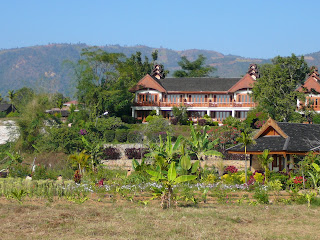
However the two waiters appear to be rejects from the cast of Fawlty Towers . They are very friendly but seem to know approximately five English words between them, none of which pertain to working in a restaurant. Add to this a menu written in English with no Burmese translation, plus the three words of Burmese that we have learned so far, which allow us to greet the waiters, and ask how they are, but are of no use for ordering food, and any reasonably intelligent restaurant owner can see there will be a problem. We tried the English method of communication in such circumstances which is speaking very slowly and very loudly, but that didn’t work. Then we tried pointing at each item on the menu, but as the waiters couldn’t read English, that didn’t work either. Finally we got hold of the waiters’ fingers and stuck them on the menu items we wanted, and sent them off to the kitchen, hoping that their fingers didn’t move between here and there, and that someone in the kitchen would know what they were pointing at. Our success rate was about 60% which seemed acceptable until they brought out a large eel on a plate.

Opening a bottle of wine also proved to be a challenge. Our waiter made several unsuccessful attempts, before we took pity and showed him that it was necessary to remove the foil before trying to insert the corkscrew. When he finally opened the bottle it became obvious that he had been taught that the customer should taste the wine first, but not that just one person did the tasting. On consideration, this seems like an innovation of merit.
There was also some confusion over where to place the knife and fork, but seeing as how Gordon also always gets this wrong, it just made it seem like home. In fact we had a delightful evening, mainly due to the waiters and their hilarious attempts to engage us in conversation. At the end of the evening a head waiter finally appeared, and in fluent English told us that the two waiters were trainees and this was their first week. The waiters had told him that we had been very nice to them and he had come over to personally thank us. We gracefully accepted his thanks, while what we really wanted to say, was where the hell had he been during all this.

However the two waiters appear to be rejects from the cast of Fawlty Towers . They are very friendly but seem to know approximately five English words between them, none of which pertain to working in a restaurant. Add to this a menu written in English with no Burmese translation, plus the three words of Burmese that we have learned so far, which allow us to greet the waiters, and ask how they are, but are of no use for ordering food, and any reasonably intelligent restaurant owner can see there will be a problem. We tried the English method of communication in such circumstances which is speaking very slowly and very loudly, but that didn’t work. Then we tried pointing at each item on the menu, but as the waiters couldn’t read English, that didn’t work either. Finally we got hold of the waiters’ fingers and stuck them on the menu items we wanted, and sent them off to the kitchen, hoping that their fingers didn’t move between here and there, and that someone in the kitchen would know what they were pointing at. Our success rate was about 60% which seemed acceptable until they brought out a large eel on a plate.

Opening a bottle of wine also proved to be a challenge. Our waiter made several unsuccessful attempts, before we took pity and showed him that it was necessary to remove the foil before trying to insert the corkscrew. When he finally opened the bottle it became obvious that he had been taught that the customer should taste the wine first, but not that just one person did the tasting. On consideration, this seems like an innovation of merit.
There was also some confusion over where to place the knife and fork, but seeing as how Gordon also always gets this wrong, it just made it seem like home. In fact we had a delightful evening, mainly due to the waiters and their hilarious attempts to engage us in conversation. At the end of the evening a head waiter finally appeared, and in fluent English told us that the two waiters were trainees and this was their first week. The waiters had told him that we had been very nice to them and he had come over to personally thank us. We gracefully accepted his thanks, while what we really wanted to say, was where the hell had he been during all this.
Friday, March 20, 2009
Inle Lake - A Guide's View of The Regime
Rosa, our guide, tells us that the hotels around Inle Lake have all gathered together and collected enough money to improve the road themselves, but the regime will not let them. It is hard to think of any reason for this, other than the fact that the government does not want the people to meet more tourists or increase their income.
This leads to a discussion of the state of tourism. In 1996 when Burma had only 100,000 tourists a year, the Generals decide to promote Burmese tourism. Unfortunately for the people of Burma, this had exactly the opposite effect as the rest of the world acted negatively to the Government’s promotion, and tourism dropped drastically. Since then it has been slowly recovering to the extent that Burma received 300,000 tourists in 2006. This compares to 30,000,000 that visited Thailand last year. But in 2007 Myanmar will have less than 100,000 tourists. In September and October, because of the uprising, they had almost no tourists. It is now December, their busiest month of the year and there are but a handful of tourists. She explains how this is a disaster for the poor people of Myanmar, many of whom earn their living by selling souvenirs, driving cars, or working in the hotels and restaurants. The last two months have been a terrible hardship for them, and she thanks us sincerely for coming to her country.
Rosa is scathing in her condemnation of the current regime, telling us how all the money that is collected goes directly to them, and very little gets to the people. Schools are few and far between and only primary school is free. If parents do make the sacrifice to send their children on to secondary schools, there are no jobs for them when they get out. So, particularly in the countryside, children leave school and start work at an early age. Rosa herself went to University and got a degree in Chemistry only to discover that there are no jobs for Chemical Engineers in Myanmar . She is convinced that the government does not want to educate its citizens for fear of the consequences. Poor uneducated people are much easier to control.
She goes on to say that Myanmar is a country rich in natural resources. It has oil, diamonds, rubies, and minerals, but none of the technology to exploit them. Instead the government plunders everything, selling the rights mainly to China , India and Russia , and keeping all the proceeds to themselves. Nothing filters down to the people.
The Army has 400,000 soldiers but the country has no enemies. Rosa is convinced that the figure of 400,000 soldiers that the Government admits to is vastly underestimated. There is no mandatory service for the people. Instead they keep such a large force by paying them about double what any other entry level job in the government pays, and then they throw in free housing and health care.
Finally she tells us that the daughter of one of the ruling Generals got married earlier this year and the wedding cost $5,000,000, an unheard of amount of money to almost everyone in Myanmar, and an amount that would have done an enormous amount of good if it had been spent on the people.
It is an amazingly open discussion with a Myanmar national (she prefers to call it Myanmar ) who readily admits that she loves her country and is proud of her people, but hates her Government. We arrive at our hotel feeling older, wiser and sadder.
This leads to a discussion of the state of tourism. In 1996 when Burma had only 100,000 tourists a year, the Generals decide to promote Burmese tourism. Unfortunately for the people of Burma, this had exactly the opposite effect as the rest of the world acted negatively to the Government’s promotion, and tourism dropped drastically. Since then it has been slowly recovering to the extent that Burma received 300,000 tourists in 2006. This compares to 30,000,000 that visited Thailand last year. But in 2007 Myanmar will have less than 100,000 tourists. In September and October, because of the uprising, they had almost no tourists. It is now December, their busiest month of the year and there are but a handful of tourists. She explains how this is a disaster for the poor people of Myanmar, many of whom earn their living by selling souvenirs, driving cars, or working in the hotels and restaurants. The last two months have been a terrible hardship for them, and she thanks us sincerely for coming to her country.
Rosa is scathing in her condemnation of the current regime, telling us how all the money that is collected goes directly to them, and very little gets to the people. Schools are few and far between and only primary school is free. If parents do make the sacrifice to send their children on to secondary schools, there are no jobs for them when they get out. So, particularly in the countryside, children leave school and start work at an early age. Rosa herself went to University and got a degree in Chemistry only to discover that there are no jobs for Chemical Engineers in Myanmar . She is convinced that the government does not want to educate its citizens for fear of the consequences. Poor uneducated people are much easier to control.
She goes on to say that Myanmar is a country rich in natural resources. It has oil, diamonds, rubies, and minerals, but none of the technology to exploit them. Instead the government plunders everything, selling the rights mainly to China , India and Russia , and keeping all the proceeds to themselves. Nothing filters down to the people.
The Army has 400,000 soldiers but the country has no enemies. Rosa is convinced that the figure of 400,000 soldiers that the Government admits to is vastly underestimated. There is no mandatory service for the people. Instead they keep such a large force by paying them about double what any other entry level job in the government pays, and then they throw in free housing and health care.
Finally she tells us that the daughter of one of the ruling Generals got married earlier this year and the wedding cost $5,000,000, an unheard of amount of money to almost everyone in Myanmar, and an amount that would have done an enormous amount of good if it had been spent on the people.
It is an amazingly open discussion with a Myanmar national (she prefers to call it Myanmar ) who readily admits that she loves her country and is proud of her people, but hates her Government. We arrive at our hotel feeling older, wiser and sadder.
Wednesday, March 18, 2009
Yangon - To Inle Lake
Yangon was a rather sad start to our trip, and we were beginning to wish we had listened to some of our friends who said what the hell were we thinking of, going to Myanmar. However things pick up considerably from here, and we have what turns out to be a fascinating trip. The country is almost entirely devoid of tourists and we often feel we are the only two in town!
We stay in some wonderful hotels which are virtually deserted, we eat in upscale restaurants often without other diners, we visit wonderful sites and have them to ourselves, we take a river cruise on a ship designed to carry 48 people and find just two other people on board. It is a poignant comment on the tyranny of the Burmese government. The Burmese people live with an underlying current of unbelievable political repression, but somehow, while they suffer horrendous hardships, they still keep smiling. They are a wonderful and graceful people and they welcome us everywhere we go.
From Yangon, we fly to Heho, a name that seems destined to be turned into a joke. But all thoughts of humour are thrown out of the window by a rather stern looking woman who meets us at the airport, and tells us that her name is Rosa. We try hard not to think of Rosa Klebb, from an early James Bond movie. She is to be our guide for the next four days, an altogether daunting thought. She is the complete antithesis to Paris.
We offer her what we hope is a winning smile, and settle into what proves to be a very interesting few days.
We drive to Inle Lake , which is to be our destination for the next three nights. Inle Lake is a large and very beautiful lake that is not always on the main tourist route. It is an hour’s drive from Heho. Rosa soon warms up and we discover she is a fascinating and intelligent woman who is completely open in her discussion of, and disgust for, the current regime. She starts by telling us that part of the road we will be driving on is in excellent condition, and part of the road is very poor. She also explains that part of the road is privately owned, while part of the road is owned by the government. When Gordon surmises that the good road is the government road, she laughs derisively, and tells him he is wrong. In fact the first part of the road is privately owned and is a two lane road in good condition. Just as the road deteriorates into a single uneven lane full of potholes and no sidewalk, we are stopped and have to pay a toll to travel any further. It is amazing what payment of a few dollars to the government can fail to do.
We stay in some wonderful hotels which are virtually deserted, we eat in upscale restaurants often without other diners, we visit wonderful sites and have them to ourselves, we take a river cruise on a ship designed to carry 48 people and find just two other people on board. It is a poignant comment on the tyranny of the Burmese government. The Burmese people live with an underlying current of unbelievable political repression, but somehow, while they suffer horrendous hardships, they still keep smiling. They are a wonderful and graceful people and they welcome us everywhere we go.
From Yangon, we fly to Heho, a name that seems destined to be turned into a joke. But all thoughts of humour are thrown out of the window by a rather stern looking woman who meets us at the airport, and tells us that her name is Rosa. We try hard not to think of Rosa Klebb, from an early James Bond movie. She is to be our guide for the next four days, an altogether daunting thought. She is the complete antithesis to Paris.
We offer her what we hope is a winning smile, and settle into what proves to be a very interesting few days.
We drive to Inle Lake , which is to be our destination for the next three nights. Inle Lake is a large and very beautiful lake that is not always on the main tourist route. It is an hour’s drive from Heho. Rosa soon warms up and we discover she is a fascinating and intelligent woman who is completely open in her discussion of, and disgust for, the current regime. She starts by telling us that part of the road we will be driving on is in excellent condition, and part of the road is very poor. She also explains that part of the road is privately owned, while part of the road is owned by the government. When Gordon surmises that the good road is the government road, she laughs derisively, and tells him he is wrong. In fact the first part of the road is privately owned and is a two lane road in good condition. Just as the road deteriorates into a single uneven lane full of potholes and no sidewalk, we are stopped and have to pay a toll to travel any further. It is amazing what payment of a few dollars to the government can fail to do.
Monday, March 9, 2009
Yangon - a Café Society
The centre of Yangon is busy with commerce, most of it done on the sidewalk.

It makes no difference whether it is clothing, books or fruit and vegetable, vendors merely lay their merchandise out on the streets, and set up shop. Stores as we know them are almost non existent, and there are no malls. What there are, are little more than holes in the wall, with no windows or doors, just metal grids that can be drawn across them at night for security, although why security is needed is unclear, as there is nothing worth stealing. Only the grandest of them have lights, and when they do it is usually just a bare bulb.
Our guide describes the city as a café society, or in this case a tea shop society. In Yangon, everyone gathers and meets at the innumerable street food establishments. Furniture, a rather grand name for an odd assortment of plastic chairs and tables, is all miniature, the type that WalMart sells (not that I have ever been in WalMart) for our kids to play with in the garden or on the beach. There are two problems with this arrangement: one, my knees won’t allow me to sit that low, and two my bum could not possibly fit into one of those tiny chairs. However the Burmese sit like this for hours, which only proves how awful their homes are, if they would rather meet here.

And if the furniture doesn’t dissuade you from frequenting these places, the service will. There are no knives and forks, and no chopsticks. In fact, no utensils of any kind. All eating is done with the fingers of your right hand. Likewise all the food is served to you by the fingers of the chef. Most Burmese still eat with their fingers in their homes. The use of knives and forks only occurs in the nicer tourist restaurants and hotels.

It makes no difference whether it is clothing, books or fruit and vegetable, vendors merely lay their merchandise out on the streets, and set up shop. Stores as we know them are almost non existent, and there are no malls. What there are, are little more than holes in the wall, with no windows or doors, just metal grids that can be drawn across them at night for security, although why security is needed is unclear, as there is nothing worth stealing. Only the grandest of them have lights, and when they do it is usually just a bare bulb.
Our guide describes the city as a café society, or in this case a tea shop society. In Yangon, everyone gathers and meets at the innumerable street food establishments. Furniture, a rather grand name for an odd assortment of plastic chairs and tables, is all miniature, the type that WalMart sells (not that I have ever been in WalMart) for our kids to play with in the garden or on the beach. There are two problems with this arrangement: one, my knees won’t allow me to sit that low, and two my bum could not possibly fit into one of those tiny chairs. However the Burmese sit like this for hours, which only proves how awful their homes are, if they would rather meet here.

And if the furniture doesn’t dissuade you from frequenting these places, the service will. There are no knives and forks, and no chopsticks. In fact, no utensils of any kind. All eating is done with the fingers of your right hand. Likewise all the food is served to you by the fingers of the chef. Most Burmese still eat with their fingers in their homes. The use of knives and forks only occurs in the nicer tourist restaurants and hotels.
Monday, March 2, 2009
Introduction
Two gay men traveling the world and noting their impressions; Is that how I want to introduce this blog? Well it certainly is what the blog is all about. Does the fact that we are gay matter? Well only in the sense that some of the adventures you will hear about may not happen to other travelers. Does the fact that we are English, but have lived in California for the last 30 years, matter. Well I think it makes for an interesting dichotomy in our outlook. It means we can travel on either passport, but at the time of writing they may be looked on as two of the most unpopular passports in the world. We have the reserve of the English, but with a patina of the California laid-back style. We love to take Cruises but often do not enjoy our fellow shipmates. Whenever possible we refuse to take the scheduled day trips on organized buses to prearranged destinations. Instead we make our own day trips, sometimes driving ourselves in countries where we cannot read the road signs, which can be a lot more entertaining, and often means we have no idea where we are. We love to travel in style and comfort as much as our situation allows, but we also love to travel to out-of-the-way-places where style and comfort are not available. We love to meet people from all over the world and hear their stories and learn how they live.
If you stay with us on our journeys, you will read about the places we visit, and learn about the people we meet. You will also come to know a little about me. You will see that I enjoy the small moments of our travels, particularly if they have a sense of the absurd about them. You will also realize that I delight in the observation of the people around me, and may not always describe them in the most flattering light. But in all cases the names are changed so as not to cause offense.
I hope my stories will make you laugh, and occasionally make you cry. But most of all I hope the stories make you care. Care about the world we live in, care about the people we meet, from the hill tribes of Burma to the Maoris of New Zealand, and care enough to maybe make some journeys of your own.
I will start with Burma. We took this trip a little over a year ago, in November and December of 2007. We were to fly to Burma just 2 months after the uprisings and suppression of the monks took place. We couldn’t decide whether to go or not. We felt that by going we would be supporting the Junta, but we heard that the people of Burma desperately wanted the tourists to return. Without the tourists so many people had no income. So in the end we decide to go and tomorrow I will begin to tell you of our travels, the people we met and our impressions.
If you stay with us on our journeys, you will read about the places we visit, and learn about the people we meet. You will also come to know a little about me. You will see that I enjoy the small moments of our travels, particularly if they have a sense of the absurd about them. You will also realize that I delight in the observation of the people around me, and may not always describe them in the most flattering light. But in all cases the names are changed so as not to cause offense.
I hope my stories will make you laugh, and occasionally make you cry. But most of all I hope the stories make you care. Care about the world we live in, care about the people we meet, from the hill tribes of Burma to the Maoris of New Zealand, and care enough to maybe make some journeys of your own.
I will start with Burma. We took this trip a little over a year ago, in November and December of 2007. We were to fly to Burma just 2 months after the uprisings and suppression of the monks took place. We couldn’t decide whether to go or not. We felt that by going we would be supporting the Junta, but we heard that the people of Burma desperately wanted the tourists to return. Without the tourists so many people had no income. So in the end we decide to go and tomorrow I will begin to tell you of our travels, the people we met and our impressions.
Subscribe to:
Comments (Atom)
