We get off the Turibus at the area called the Zocolo . This is the historic, political and cultural heart of Mexico City. It is built on top of the remains of the centre of the Aztec Empire, which in turn was built on top of a series of lakes and canals. The Spanish drained the waterways but the land was still little more than a swamp. Since then, the soft ground and the pumping of underground water for the city’s needs has meant that much of Mexico City’s historic heart is sinking. The Catedral Metropolitana alone has sunk 7m (23ft) since it was built. It is one of the most impressive baroque cathedrals in the world. But much of it appears to be leaning at a rather alarming angle. Indeed it is hard to see some of the gorgeous interior because of all the scaffolding needed to keep the massive structure from collapsing.
The streets of the Zocolo are narrow and lined with architectural examples from every period of Mexican history. Again the streets are all closed to traffic and the area is full of pedestrians. There are sidewalk cafes and restaurants, trendy stores, street musicians and a lot of police. The police presence is strong throughout the city. Many of them ride Segways, which seems extravagant for a poor country. The number of police is actually a little alarming, as is the fact that nearly all stores and restaurants of any size employ security guards to stand at their door. Even Burger King employs security guards, which seems a little superfluous. What self respecting crook would want to steal a Burger King sandwich. We have been warned to be careful, especially at night, but we feel perfectly safe in the tourist areas.
Showing posts with label travel tips. Show all posts
Showing posts with label travel tips. Show all posts
Monday, September 7, 2009


Monday, August 31, 2009
A Trip to Mexico City
We spend several months a year in Puerto Vallarta and love it. In fact we love it so much we have never left it to explore the rest of the country. But today we are finally doing something about that. We are flying to Mexico City for three days to start off a 15 day trip to the east of the country.
We are doing all our flights on Aviacsa Airlines, one of Mexico’s new low cost airlines, and are impressed by the clean new planes, the ample leg room and the efficient service.
We have heard horror stories about Mexico City’s huge airport, and expect the worst. But we are pleasantly surprised. Admittedly we arrive at the domestic terminal, and not the International one, but we are off the plane and into a taxi, with our luggage in hand all in the space of 15 minutes.
The taxis too are a vast improvement on the ones we are used to in Puerto Vallarta. These are new, clean and metered. The driver is wearing an elegantly pressed white shirt and tie with a rather natty waistcoat.
We are staying in the Zona Rosa, which everyone tells us is a lively and safe neighborhood close to the City center. It is one of the city's most touristy areas, filled with hotels, dance clubs, restaurants, bars and live music. Zona Rosa means “the Pink Area” which is appropriate as it is home to a large gay population. Our hotel is on Londres Street which no one told us was THE gay street. It is packed with mainly young gay men. Mexico City has passed a law allowing gay unions, an extremely advanced action for a Catholic country. The young gays in the area are definitely out and proud, many holding hands as they walk along the street.
We are amused to see that the latest street fashion for these young men is extremely tight jeans often paired with white Go Go boots. Their main accessory is hair gel, which they appear to ladle on with a trowel.
We are staying at the EuroStars Zona Rosa Suites Hotel, which was obviously a very hip hotel in its day, but its day passed several years ago and now it is comfortable but fading.
We are doing all our flights on Aviacsa Airlines, one of Mexico’s new low cost airlines, and are impressed by the clean new planes, the ample leg room and the efficient service.
We have heard horror stories about Mexico City’s huge airport, and expect the worst. But we are pleasantly surprised. Admittedly we arrive at the domestic terminal, and not the International one, but we are off the plane and into a taxi, with our luggage in hand all in the space of 15 minutes.
The taxis too are a vast improvement on the ones we are used to in Puerto Vallarta. These are new, clean and metered. The driver is wearing an elegantly pressed white shirt and tie with a rather natty waistcoat.
We are staying in the Zona Rosa, which everyone tells us is a lively and safe neighborhood close to the City center. It is one of the city's most touristy areas, filled with hotels, dance clubs, restaurants, bars and live music. Zona Rosa means “the Pink Area” which is appropriate as it is home to a large gay population. Our hotel is on Londres Street which no one told us was THE gay street. It is packed with mainly young gay men. Mexico City has passed a law allowing gay unions, an extremely advanced action for a Catholic country. The young gays in the area are definitely out and proud, many holding hands as they walk along the street.
We are amused to see that the latest street fashion for these young men is extremely tight jeans often paired with white Go Go boots. Their main accessory is hair gel, which they appear to ladle on with a trowel.
We are staying at the EuroStars Zona Rosa Suites Hotel, which was obviously a very hip hotel in its day, but its day passed several years ago and now it is comfortable but fading.
Monday, July 6, 2009
Mandalay - The First Sights
A magical morning as we sail into Mandalay. We sail under two iron bridges with hills on either side, full of golden stuppas that glisten in the early morning sun.

Small fishing boats with one solid bright coloured sail, emerge slowly out of the mists and smoke that rise off the land and drift across the wide river. Ships carrying huge piles of rice chug along the river and are laden to the point where it seems that they would sink if you loaded one more sack on board. The ships are as old and dilapidated as the buses from the 1940’s, and their crews aren’t much better. They are all in dirty white T shirts and ragged longyis, and they wave as we go by.

It is exactly as we imagined it as kids in school, reading Rudyard Kipling and learning about the glory days of the British Empire.
Once ashore we are met by our new guide, Min, a woman of about 40 suffering from a severe case of flu. It seems that half the country is in the grips of flu.. A Boy named Sue had it, but not badly, his driver had it, the two other passengers on the ship had it, two of the crew had it, and it is obvious that many people we see have it. But no one has seemed as sick as Min, who we are sure will not make it through the day. She is dressed for winter, with a rather strange hand knitted pink wool hat pulled down to her eyebrows, and a matching scarf wrapped twice round her neck and mouth. She has a huge padded coat which she holds tightly around her body, boots and a pair of gloves. The only part of her body exposed to the elements is her eyes. Where she found this clothing is a mystery, Mandalay is always hot and we never saw a shop selling anything like these clothes. She had to blow her nose constantly, which unfortunately she did directly into her hand, and then wiped her hand with a piece of toilet paper. This was not appealing.
Both she and her husband are tour guides, and have two children. Because of the lack of tourists they were in dire straits and she has to work, no matter how sick she feels. She is only able to talk in a whisper because of her sore throat, and has to stop often to cough. We are reluctant to deprive her of the little income we are bringing her, so we control our impulse to tell her to go home.

Small fishing boats with one solid bright coloured sail, emerge slowly out of the mists and smoke that rise off the land and drift across the wide river. Ships carrying huge piles of rice chug along the river and are laden to the point where it seems that they would sink if you loaded one more sack on board. The ships are as old and dilapidated as the buses from the 1940’s, and their crews aren’t much better. They are all in dirty white T shirts and ragged longyis, and they wave as we go by.

It is exactly as we imagined it as kids in school, reading Rudyard Kipling and learning about the glory days of the British Empire.
Once ashore we are met by our new guide, Min, a woman of about 40 suffering from a severe case of flu. It seems that half the country is in the grips of flu.. A Boy named Sue had it, but not badly, his driver had it, the two other passengers on the ship had it, two of the crew had it, and it is obvious that many people we see have it. But no one has seemed as sick as Min, who we are sure will not make it through the day. She is dressed for winter, with a rather strange hand knitted pink wool hat pulled down to her eyebrows, and a matching scarf wrapped twice round her neck and mouth. She has a huge padded coat which she holds tightly around her body, boots and a pair of gloves. The only part of her body exposed to the elements is her eyes. Where she found this clothing is a mystery, Mandalay is always hot and we never saw a shop selling anything like these clothes. She had to blow her nose constantly, which unfortunately she did directly into her hand, and then wiped her hand with a piece of toilet paper. This was not appealing.
Both she and her husband are tour guides, and have two children. Because of the lack of tourists they were in dire straits and she has to work, no matter how sick she feels. She is only able to talk in a whisper because of her sore throat, and has to stop often to cough. We are reluctant to deprive her of the little income we are bringing her, so we control our impulse to tell her to go home.
Friday, April 10, 2009
Burma - The Problems of Owning A Vehicle
The government of Burma has banned the import of all cars for several years now. In a demonstration of misguided thinking that might even outdo George Bush’s skills of logic, the reason for this is that the roads are so bad, more cars would just make the roads worse. Cars have become fantastically expensive because of the scarcity of good vehicles and because the government has put a 40% tax on all car sales. Our driver's car would have cost 2 or 3 thousand dollars 6 years ago, but is now sell for $20,000.
The government has just announced that it will allow a few new cars to be imported, but they are only to be used as taxis and car hire vehicles.
This brings on yet another round of complaints about the government. All gas (petrol) is rationed. The cheapest motorbike on the market is Chinese. If you buy one of these with a license, you are allowed 4 gallons of gas a month. If you can afford the much better and much more expensive Japanese bike with a license you get 10 gallons a month. However if you get a bike on the black market with no license (much cheaper that way), then you get no gas. This of course has led to a thriving black market for gas to which the government turns a blind eye. Gas from the government costs $1.50 a gallon, but on the black market it costs twice as much. (It was the Generals putting up the price to $1.50 that started the recent troubles).
Cars are only allowed 8 gallons of gas a month, so now we know why there are so few cars on the road. A couple of years ago, the tourist industry gathered together and petitioned the government for more gas for the taxis that take the tourists around. The government agreed and allowed the taxis more gas. But this arrangement only lasted for one month. So the taxis are almost totally dependent on black market gas.
Most towns or cities only have a very few government gas stations, consequently the Burmese have to allow an hour of their time each week to line up for their ration of gas.
The government has just announced that it will allow a few new cars to be imported, but they are only to be used as taxis and car hire vehicles.
This brings on yet another round of complaints about the government. All gas (petrol) is rationed. The cheapest motorbike on the market is Chinese. If you buy one of these with a license, you are allowed 4 gallons of gas a month. If you can afford the much better and much more expensive Japanese bike with a license you get 10 gallons a month. However if you get a bike on the black market with no license (much cheaper that way), then you get no gas. This of course has led to a thriving black market for gas to which the government turns a blind eye. Gas from the government costs $1.50 a gallon, but on the black market it costs twice as much. (It was the Generals putting up the price to $1.50 that started the recent troubles).
Cars are only allowed 8 gallons of gas a month, so now we know why there are so few cars on the road. A couple of years ago, the tourist industry gathered together and petitioned the government for more gas for the taxis that take the tourists around. The government agreed and allowed the taxis more gas. But this arrangement only lasted for one month. So the taxis are almost totally dependent on black market gas.
Most towns or cities only have a very few government gas stations, consequently the Burmese have to allow an hour of their time each week to line up for their ration of gas.
Wednesday, April 8, 2009
Pindaya Caves - The Road There
We drive to Pindaya to see the famous caves filled with Buddhas. It is a 50 mile journey that takes 3 hours because of the appalling road. The road is in fact the main route to Yangon , but it is in terrible condition, only wide enough for one vehicle and full of potholes , with entire sections actually without a hard surface. Most of the roads were built by the British pre1948 and have not been touched since. Because this is a major route it is busy with buses and large trucks. It is impossible to pass anything unless you can persuade them, by continually blowing your horn, to move off the road. When a vehicle is coming the other way, one of you has to move on to the unmade verge. Consequently a lot of the drive involves playing the game of chicken.
A remarkable number of vehicles on the road are actually animal driven. They are either large carts piled high with produce being pulled by two oxen, or water buffalo, or a small passenger trap being driven by even smaller horses.


There are also a large number of bicycles, all of which look like antiques and are of the “sit up and beg” variety, with huge wheels. Other than that, the most common transport is a tractor straight out of the 1950’s, that has been converted into a small truck. The front part is still obviously the front of a small tractor while the back half has been transformed into a sort of flat bed truck, used for hauling produce or just as often, a large number of people.

There are very few regular cars, and those that we do see are, as before, old Toyotas from the 80’s. Our driver tells us that he bought his car used, fifteen years ago. When we comment that it has lasted well considering the road conditions, he gets quite agitated and says that it has to be repaired at least once a month. Cars are fantastically expensive to buy as they have a tax of 40% added on by the government, and to add insult to injury, we are stopped every 15 miles or so to pay a road toll.
A remarkable number of vehicles on the road are actually animal driven. They are either large carts piled high with produce being pulled by two oxen, or water buffalo, or a small passenger trap being driven by even smaller horses.


There are also a large number of bicycles, all of which look like antiques and are of the “sit up and beg” variety, with huge wheels. Other than that, the most common transport is a tractor straight out of the 1950’s, that has been converted into a small truck. The front part is still obviously the front of a small tractor while the back half has been transformed into a sort of flat bed truck, used for hauling produce or just as often, a large number of people.

There are very few regular cars, and those that we do see are, as before, old Toyotas from the 80’s. Our driver tells us that he bought his car used, fifteen years ago. When we comment that it has lasted well considering the road conditions, he gets quite agitated and says that it has to be repaired at least once a month. Cars are fantastically expensive to buy as they have a tax of 40% added on by the government, and to add insult to injury, we are stopped every 15 miles or so to pay a road toll.
Wednesday, April 1, 2009
Inle Lake - We Take Tea
 The house fills up rapidly with people, some family, some neighbours, all come to meet the foreigners. There is an eighty year old woman who lives next door, and several toddlers. They all sit in a big circle round us on the floor. Tea is made and offered. They are all charming and entertaining and interested in us, with a lively sense of humour. They want to know where our families are, and when we say we do not have families, they invite us to join theirs. Now, as I am sure you appreciate, there is absolutely no way on God’s Earth that this is going to happen, but I manage a gracious smile, and say that I would love to, as long as they didn’t expect me to row with one leg. There is much laughter. After a while one of the daughters disappears into the kitchen and returns some time later with the most delicious potato crisps we ever tasted. She has just made them over the open fire in their tiny kitchen. Considering the place is made of wood and reeds, the open fire seems a little dangerous and we ask if their houses ever catch fire. This is cause for a lot more laughter, even though the answer is yes.
We stay well over an hour and feel very comfortable. They are genuinely welcoming and we are touched by the whole experience, particularly when we leave and the father turns to me and says that he hopes we will be brothers in our next life. They are the poorest people we are ever likely to meet, but their quality of life appears rich indeed.

After further visits to a floating farm and a weaving business, we return to our hotel for dinner. There is a card on the table advertising tonight’s special appetizer, which is mussels cooked in butter and garlic. We point to that assuming the waiters must know about it. We do get them, but unfortunately they arrive about 30 minutes after the main course. There are a total of six mussels on a plate and are served with profuse apologies from the head waiter and little else.
Monday, March 30, 2009
Inle Lake - We Visit A Home
The next village we visit on Inle Lake is a fishing village, and actually in the lake, rather than along the waters edge like the last two. The streets of this village are waterways with rows of stilt houses on either side.

Some have little floating gardens, and hedges, others have pots with plants in them on a platform. All have small landing jetties for their boats. It is from one of these jetties that we are greeted by a mother and young daughter. They wave as we go by, and the driver takes the boat over to them and we start to speak to them through our guide. We are invited into their house and we readily accept. We go up the steps from the jetty into the usual two room affair with no furniture other than two old wicker chairs kept for important guests, which in this case turns out to be us. Everyone else sleeps, sits and eats on the floor. Is this why everyone takes their shoes off when entering a house, because basically you are walking on their dining table?
We learn that the parents have 14 children, presumably a result of living in the middle of a lake where there is little in the way of evening entertainment.

The parents sleep in one room and all the children sleep in the other, which is their main living room. No one leaves home until they get married. There is a small kitchen off the back, and a bamboo bridge to a separate “privy”. The privy has a modern style toilet, but no plumbing. It just sits over a hole in the floor and empties into the lake. There are 16 people living in this house, using this toilet, and it is just one of hundreds of similar houses. Suddenly we are not so hungry for fresh fish from the lake.

Some have little floating gardens, and hedges, others have pots with plants in them on a platform. All have small landing jetties for their boats. It is from one of these jetties that we are greeted by a mother and young daughter. They wave as we go by, and the driver takes the boat over to them and we start to speak to them through our guide. We are invited into their house and we readily accept. We go up the steps from the jetty into the usual two room affair with no furniture other than two old wicker chairs kept for important guests, which in this case turns out to be us. Everyone else sleeps, sits and eats on the floor. Is this why everyone takes their shoes off when entering a house, because basically you are walking on their dining table?
We learn that the parents have 14 children, presumably a result of living in the middle of a lake where there is little in the way of evening entertainment.

The parents sleep in one room and all the children sleep in the other, which is their main living room. No one leaves home until they get married. There is a small kitchen off the back, and a bamboo bridge to a separate “privy”. The privy has a modern style toilet, but no plumbing. It just sits over a hole in the floor and empties into the lake. There are 16 people living in this house, using this toilet, and it is just one of hundreds of similar houses. Suddenly we are not so hungry for fresh fish from the lake.
Friday, March 27, 2009
Inle Lake - A Day
We have heard that Inle lake is severely over fished, with catches getting smaller and smaller and as we set out to explore the lake it is immediately obvious why. The lake is covered with small boats each with a man fishing. They are in boats very similar to ours but a little shorter and without an engine.

Some drive fish towards nets by beating the water with long poles. Others stand on the small platform at the front, and wrap their leg around a long oar. Using a combined twisting of their body and circling motion of their leg they can propel the boat, and make girls hearts flutter on the dance floor. On the boat it leaves both hands free to fish, which they do with a fishing line, a net, or a huge cone shaped bamboo “beehive”.

These are the famous fishermen of Inle Lake and it is fascinating to watch them. Many of them are friendly and come along side our boat so that we can take pictures and exchange smiles of greeting.

We pay our first visit to a village where we meet the Pao tribe. The women wear all black with a colourful headdress, which actually looks like a small blanket folded neatly on top of their head, which must come in handy as it gets quite cold at night. You can tell which village they come from by the colour of this blanket. We go to see one of their markets, which is a desultory affair, with desperately poor looking women trying to sell tiny amounts of vegetables or spices.

Many of the women are smoking large fat cigars. We are not sure what is in the cigars, but they certainly seem happier than their immediate surroundings would warrant.

From here we go along the lake to the next village to see the Paduang tribe, famous for their long necked women.

The women wear gold coloured metal coils around their necks and calves. It gives the women very long necks, but apparently doesn’t actually stretch the neck, rather it pushes down the collar bone. They can take the coils off, but have to be extremely careful for three weeks until their collar bone recovers its original position. The origin of this is to protect from tigers, which always attack either the legs or the neck. There are only a handful of these women left, not because all the others have been killed by tigers, but because the majority of the tribe crossed the border to Thailand where they can make much more money from the tourist industry.

Some drive fish towards nets by beating the water with long poles. Others stand on the small platform at the front, and wrap their leg around a long oar. Using a combined twisting of their body and circling motion of their leg they can propel the boat, and make girls hearts flutter on the dance floor. On the boat it leaves both hands free to fish, which they do with a fishing line, a net, or a huge cone shaped bamboo “beehive”.

These are the famous fishermen of Inle Lake and it is fascinating to watch them. Many of them are friendly and come along side our boat so that we can take pictures and exchange smiles of greeting.

We pay our first visit to a village where we meet the Pao tribe. The women wear all black with a colourful headdress, which actually looks like a small blanket folded neatly on top of their head, which must come in handy as it gets quite cold at night. You can tell which village they come from by the colour of this blanket. We go to see one of their markets, which is a desultory affair, with desperately poor looking women trying to sell tiny amounts of vegetables or spices.

Many of the women are smoking large fat cigars. We are not sure what is in the cigars, but they certainly seem happier than their immediate surroundings would warrant.

From here we go along the lake to the next village to see the Paduang tribe, famous for their long necked women.

The women wear gold coloured metal coils around their necks and calves. It gives the women very long necks, but apparently doesn’t actually stretch the neck, rather it pushes down the collar bone. They can take the coils off, but have to be extremely careful for three weeks until their collar bone recovers its original position. The origin of this is to protect from tigers, which always attack either the legs or the neck. There are only a handful of these women left, not because all the others have been killed by tigers, but because the majority of the tribe crossed the border to Thailand where they can make much more money from the tourist industry.
Wednesday, March 25, 2009
Inle Lake - Transportation
We are to spend the next two days on Inle Lake exploring all the villages and the life of the locals. The lake is about 15 miles long and anything from a few hundred yards to a mile or so wide. 125,000 people inhabit its shores, mainly living in small villages built on stilts above the water.

The houses are simple two room affairs built of bamboo and reeds. They last ten years before they fall apart, and then the entire village gets together to build a replacement. The people either fish or farm, and their method of doing both is part of the reason we have come here.
Our hotel has a jetty leading out to a small inlet and it is here we find our transport for the next two days. The boat is shaped like a dugout canoe, only much longer. It must be twenty five feet long and little more than 2ft 6 wide. It has an extremely shallow draught, because the lake itself is often a little more than a couple of feet deep. The front rises up out of the water, and the back end has what looks like an old lawn mower engine sitting on a platform with an eight foot metal rod running directly from it to a small propeller. In this way the driver can make sure the propeller just skims the surface of the water and doesn’t hit the bottom or get caught in weeds.
There are three wooden arm chairs for the tourists. Each chair comes with a rather worn cushion, and an umbrella. We are told the boat is extremely unstable because of its shallow draft, so we must step directly into the middle of the boat, and not on to the sides.

Once we take our seats, the driver starts the engine which coughs and sputters a few times and then lets out a high pitch wine. The boat shoots forward like a bat out of hell. The smallest turn causes it to lean to one side in the most alarming fashion. Conversation with the person behind you is almost impossible because of, one, the noise of the engine, and two, the act of turning round causes the boat to wobble. Strangely enough, just as an ocean going liner attracts a flock of seagulls following it, so does this small rocket boat.


The houses are simple two room affairs built of bamboo and reeds. They last ten years before they fall apart, and then the entire village gets together to build a replacement. The people either fish or farm, and their method of doing both is part of the reason we have come here.
Our hotel has a jetty leading out to a small inlet and it is here we find our transport for the next two days. The boat is shaped like a dugout canoe, only much longer. It must be twenty five feet long and little more than 2ft 6 wide. It has an extremely shallow draught, because the lake itself is often a little more than a couple of feet deep. The front rises up out of the water, and the back end has what looks like an old lawn mower engine sitting on a platform with an eight foot metal rod running directly from it to a small propeller. In this way the driver can make sure the propeller just skims the surface of the water and doesn’t hit the bottom or get caught in weeds.
There are three wooden arm chairs for the tourists. Each chair comes with a rather worn cushion, and an umbrella. We are told the boat is extremely unstable because of its shallow draft, so we must step directly into the middle of the boat, and not on to the sides.

Once we take our seats, the driver starts the engine which coughs and sputters a few times and then lets out a high pitch wine. The boat shoots forward like a bat out of hell. The smallest turn causes it to lean to one side in the most alarming fashion. Conversation with the person behind you is almost impossible because of, one, the noise of the engine, and two, the act of turning round causes the boat to wobble. Strangely enough, just as an ocean going liner attracts a flock of seagulls following it, so does this small rocket boat.

Monday, March 23, 2009
Inle Lake - Our First Evening
As if to echo our guide Rosa’s, thoughts on tourism, we find that there are only 6 people, including us, staying in our hotel. The restaurant overlooks the hotels own vegetable garden which augers well.
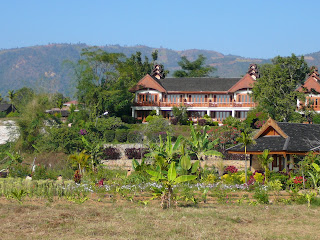
However the two waiters appear to be rejects from the cast of Fawlty Towers . They are very friendly but seem to know approximately five English words between them, none of which pertain to working in a restaurant. Add to this a menu written in English with no Burmese translation, plus the three words of Burmese that we have learned so far, which allow us to greet the waiters, and ask how they are, but are of no use for ordering food, and any reasonably intelligent restaurant owner can see there will be a problem. We tried the English method of communication in such circumstances which is speaking very slowly and very loudly, but that didn’t work. Then we tried pointing at each item on the menu, but as the waiters couldn’t read English, that didn’t work either. Finally we got hold of the waiters’ fingers and stuck them on the menu items we wanted, and sent them off to the kitchen, hoping that their fingers didn’t move between here and there, and that someone in the kitchen would know what they were pointing at. Our success rate was about 60% which seemed acceptable until they brought out a large eel on a plate.

Opening a bottle of wine also proved to be a challenge. Our waiter made several unsuccessful attempts, before we took pity and showed him that it was necessary to remove the foil before trying to insert the corkscrew. When he finally opened the bottle it became obvious that he had been taught that the customer should taste the wine first, but not that just one person did the tasting. On consideration, this seems like an innovation of merit.
There was also some confusion over where to place the knife and fork, but seeing as how Gordon also always gets this wrong, it just made it seem like home. In fact we had a delightful evening, mainly due to the waiters and their hilarious attempts to engage us in conversation. At the end of the evening a head waiter finally appeared, and in fluent English told us that the two waiters were trainees and this was their first week. The waiters had told him that we had been very nice to them and he had come over to personally thank us. We gracefully accepted his thanks, while what we really wanted to say, was where the hell had he been during all this.

However the two waiters appear to be rejects from the cast of Fawlty Towers . They are very friendly but seem to know approximately five English words between them, none of which pertain to working in a restaurant. Add to this a menu written in English with no Burmese translation, plus the three words of Burmese that we have learned so far, which allow us to greet the waiters, and ask how they are, but are of no use for ordering food, and any reasonably intelligent restaurant owner can see there will be a problem. We tried the English method of communication in such circumstances which is speaking very slowly and very loudly, but that didn’t work. Then we tried pointing at each item on the menu, but as the waiters couldn’t read English, that didn’t work either. Finally we got hold of the waiters’ fingers and stuck them on the menu items we wanted, and sent them off to the kitchen, hoping that their fingers didn’t move between here and there, and that someone in the kitchen would know what they were pointing at. Our success rate was about 60% which seemed acceptable until they brought out a large eel on a plate.

Opening a bottle of wine also proved to be a challenge. Our waiter made several unsuccessful attempts, before we took pity and showed him that it was necessary to remove the foil before trying to insert the corkscrew. When he finally opened the bottle it became obvious that he had been taught that the customer should taste the wine first, but not that just one person did the tasting. On consideration, this seems like an innovation of merit.
There was also some confusion over where to place the knife and fork, but seeing as how Gordon also always gets this wrong, it just made it seem like home. In fact we had a delightful evening, mainly due to the waiters and their hilarious attempts to engage us in conversation. At the end of the evening a head waiter finally appeared, and in fluent English told us that the two waiters were trainees and this was their first week. The waiters had told him that we had been very nice to them and he had come over to personally thank us. We gracefully accepted his thanks, while what we really wanted to say, was where the hell had he been during all this.
Friday, March 20, 2009
Inle Lake - A Guide's View of The Regime
Rosa, our guide, tells us that the hotels around Inle Lake have all gathered together and collected enough money to improve the road themselves, but the regime will not let them. It is hard to think of any reason for this, other than the fact that the government does not want the people to meet more tourists or increase their income.
This leads to a discussion of the state of tourism. In 1996 when Burma had only 100,000 tourists a year, the Generals decide to promote Burmese tourism. Unfortunately for the people of Burma, this had exactly the opposite effect as the rest of the world acted negatively to the Government’s promotion, and tourism dropped drastically. Since then it has been slowly recovering to the extent that Burma received 300,000 tourists in 2006. This compares to 30,000,000 that visited Thailand last year. But in 2007 Myanmar will have less than 100,000 tourists. In September and October, because of the uprising, they had almost no tourists. It is now December, their busiest month of the year and there are but a handful of tourists. She explains how this is a disaster for the poor people of Myanmar, many of whom earn their living by selling souvenirs, driving cars, or working in the hotels and restaurants. The last two months have been a terrible hardship for them, and she thanks us sincerely for coming to her country.
Rosa is scathing in her condemnation of the current regime, telling us how all the money that is collected goes directly to them, and very little gets to the people. Schools are few and far between and only primary school is free. If parents do make the sacrifice to send their children on to secondary schools, there are no jobs for them when they get out. So, particularly in the countryside, children leave school and start work at an early age. Rosa herself went to University and got a degree in Chemistry only to discover that there are no jobs for Chemical Engineers in Myanmar . She is convinced that the government does not want to educate its citizens for fear of the consequences. Poor uneducated people are much easier to control.
She goes on to say that Myanmar is a country rich in natural resources. It has oil, diamonds, rubies, and minerals, but none of the technology to exploit them. Instead the government plunders everything, selling the rights mainly to China , India and Russia , and keeping all the proceeds to themselves. Nothing filters down to the people.
The Army has 400,000 soldiers but the country has no enemies. Rosa is convinced that the figure of 400,000 soldiers that the Government admits to is vastly underestimated. There is no mandatory service for the people. Instead they keep such a large force by paying them about double what any other entry level job in the government pays, and then they throw in free housing and health care.
Finally she tells us that the daughter of one of the ruling Generals got married earlier this year and the wedding cost $5,000,000, an unheard of amount of money to almost everyone in Myanmar, and an amount that would have done an enormous amount of good if it had been spent on the people.
It is an amazingly open discussion with a Myanmar national (she prefers to call it Myanmar ) who readily admits that she loves her country and is proud of her people, but hates her Government. We arrive at our hotel feeling older, wiser and sadder.
This leads to a discussion of the state of tourism. In 1996 when Burma had only 100,000 tourists a year, the Generals decide to promote Burmese tourism. Unfortunately for the people of Burma, this had exactly the opposite effect as the rest of the world acted negatively to the Government’s promotion, and tourism dropped drastically. Since then it has been slowly recovering to the extent that Burma received 300,000 tourists in 2006. This compares to 30,000,000 that visited Thailand last year. But in 2007 Myanmar will have less than 100,000 tourists. In September and October, because of the uprising, they had almost no tourists. It is now December, their busiest month of the year and there are but a handful of tourists. She explains how this is a disaster for the poor people of Myanmar, many of whom earn their living by selling souvenirs, driving cars, or working in the hotels and restaurants. The last two months have been a terrible hardship for them, and she thanks us sincerely for coming to her country.
Rosa is scathing in her condemnation of the current regime, telling us how all the money that is collected goes directly to them, and very little gets to the people. Schools are few and far between and only primary school is free. If parents do make the sacrifice to send their children on to secondary schools, there are no jobs for them when they get out. So, particularly in the countryside, children leave school and start work at an early age. Rosa herself went to University and got a degree in Chemistry only to discover that there are no jobs for Chemical Engineers in Myanmar . She is convinced that the government does not want to educate its citizens for fear of the consequences. Poor uneducated people are much easier to control.
She goes on to say that Myanmar is a country rich in natural resources. It has oil, diamonds, rubies, and minerals, but none of the technology to exploit them. Instead the government plunders everything, selling the rights mainly to China , India and Russia , and keeping all the proceeds to themselves. Nothing filters down to the people.
The Army has 400,000 soldiers but the country has no enemies. Rosa is convinced that the figure of 400,000 soldiers that the Government admits to is vastly underestimated. There is no mandatory service for the people. Instead they keep such a large force by paying them about double what any other entry level job in the government pays, and then they throw in free housing and health care.
Finally she tells us that the daughter of one of the ruling Generals got married earlier this year and the wedding cost $5,000,000, an unheard of amount of money to almost everyone in Myanmar, and an amount that would have done an enormous amount of good if it had been spent on the people.
It is an amazingly open discussion with a Myanmar national (she prefers to call it Myanmar ) who readily admits that she loves her country and is proud of her people, but hates her Government. We arrive at our hotel feeling older, wiser and sadder.
Wednesday, March 18, 2009
Yangon - To Inle Lake
Yangon was a rather sad start to our trip, and we were beginning to wish we had listened to some of our friends who said what the hell were we thinking of, going to Myanmar. However things pick up considerably from here, and we have what turns out to be a fascinating trip. The country is almost entirely devoid of tourists and we often feel we are the only two in town!
We stay in some wonderful hotels which are virtually deserted, we eat in upscale restaurants often without other diners, we visit wonderful sites and have them to ourselves, we take a river cruise on a ship designed to carry 48 people and find just two other people on board. It is a poignant comment on the tyranny of the Burmese government. The Burmese people live with an underlying current of unbelievable political repression, but somehow, while they suffer horrendous hardships, they still keep smiling. They are a wonderful and graceful people and they welcome us everywhere we go.
From Yangon, we fly to Heho, a name that seems destined to be turned into a joke. But all thoughts of humour are thrown out of the window by a rather stern looking woman who meets us at the airport, and tells us that her name is Rosa. We try hard not to think of Rosa Klebb, from an early James Bond movie. She is to be our guide for the next four days, an altogether daunting thought. She is the complete antithesis to Paris.
We offer her what we hope is a winning smile, and settle into what proves to be a very interesting few days.
We drive to Inle Lake , which is to be our destination for the next three nights. Inle Lake is a large and very beautiful lake that is not always on the main tourist route. It is an hour’s drive from Heho. Rosa soon warms up and we discover she is a fascinating and intelligent woman who is completely open in her discussion of, and disgust for, the current regime. She starts by telling us that part of the road we will be driving on is in excellent condition, and part of the road is very poor. She also explains that part of the road is privately owned, while part of the road is owned by the government. When Gordon surmises that the good road is the government road, she laughs derisively, and tells him he is wrong. In fact the first part of the road is privately owned and is a two lane road in good condition. Just as the road deteriorates into a single uneven lane full of potholes and no sidewalk, we are stopped and have to pay a toll to travel any further. It is amazing what payment of a few dollars to the government can fail to do.
We stay in some wonderful hotels which are virtually deserted, we eat in upscale restaurants often without other diners, we visit wonderful sites and have them to ourselves, we take a river cruise on a ship designed to carry 48 people and find just two other people on board. It is a poignant comment on the tyranny of the Burmese government. The Burmese people live with an underlying current of unbelievable political repression, but somehow, while they suffer horrendous hardships, they still keep smiling. They are a wonderful and graceful people and they welcome us everywhere we go.
From Yangon, we fly to Heho, a name that seems destined to be turned into a joke. But all thoughts of humour are thrown out of the window by a rather stern looking woman who meets us at the airport, and tells us that her name is Rosa. We try hard not to think of Rosa Klebb, from an early James Bond movie. She is to be our guide for the next four days, an altogether daunting thought. She is the complete antithesis to Paris.
We offer her what we hope is a winning smile, and settle into what proves to be a very interesting few days.
We drive to Inle Lake , which is to be our destination for the next three nights. Inle Lake is a large and very beautiful lake that is not always on the main tourist route. It is an hour’s drive from Heho. Rosa soon warms up and we discover she is a fascinating and intelligent woman who is completely open in her discussion of, and disgust for, the current regime. She starts by telling us that part of the road we will be driving on is in excellent condition, and part of the road is very poor. She also explains that part of the road is privately owned, while part of the road is owned by the government. When Gordon surmises that the good road is the government road, she laughs derisively, and tells him he is wrong. In fact the first part of the road is privately owned and is a two lane road in good condition. Just as the road deteriorates into a single uneven lane full of potholes and no sidewalk, we are stopped and have to pay a toll to travel any further. It is amazing what payment of a few dollars to the government can fail to do.
Monday, March 16, 2009
Yangon - We Meet The Owner of The Tour Company
Our guide in Yangon, Paris, may not want to go near the American Embassy, but the British Embassy is a different story. We are actually to meet Gary, the owner of the tour company for a drink in the British Club, which is next door to the Consulate. Paris tells us that this a great honour as Gary never asks to see his clients, and very few people are allowed into the Club. We have to be signed in and Paris is very excited to find out that the invitation has been extended to him. He preens before entering, and does his film star routine again. The club itself is almost as run down as the City, and perfectly represents Britain’s former glory. There is no one there other than Gary and his general manager. Gary is a large man in his 60’s with a bulbous nose, large ears and full lips. In fact everything about him seems to stick out. He has a glass of beer in his hand, which it soon becomes apparent is a permanent fixture. He is with his manager, a Burmese man, around 40 years old, small, olive skinned with a ready smile, and a twinkle in his eye. We discover that he is also Gary’s partner in life. His name is N.T., affectionately known by one and all as Aunty.
Gary is less affectionately known as someone who never stops talking and enjoys a drink. But, like most people who drink a lot, Gary tells a good story and we laugh a lot. He is delighted to meet up with two English people and it turns out his own home in the North of Wales is where Gordon’s mother retired to. It is a very small world.
Gary had told us prior to our arrival that very few places accept credit cards, and that dollars are not accepted in Myanmar. We must change our money into Myanmar kyats, on arrival. and we will get a better exchange rate in Yangon than anywhere else. Consequently, the first thing we do is change $1000. What Gerry has not told us is that the largest note in Myanmar currency is the 1000 kyat. And that 1000 kyat is worth 75 cents. So in return for ten $100 dollar notes we get a huge stack of over twelve thousand Myanmar notes. We need a small suitcase to carry them. Unfortunately, we find out later that Gary’s information was wrong. Everywhere we go, people want dollars, and we get a much better deal if we pay in them.
Another piece of misinformation that Gary gave us was that we could bring our laptop and although all incoming and outgoing emails were blocked by the Burmese government, there were always ways around this. Many people tried to unblock our emails, but no one succeeded.
Gary is less affectionately known as someone who never stops talking and enjoys a drink. But, like most people who drink a lot, Gary tells a good story and we laugh a lot. He is delighted to meet up with two English people and it turns out his own home in the North of Wales is where Gordon’s mother retired to. It is a very small world.
Gary had told us prior to our arrival that very few places accept credit cards, and that dollars are not accepted in Myanmar. We must change our money into Myanmar kyats, on arrival. and we will get a better exchange rate in Yangon than anywhere else. Consequently, the first thing we do is change $1000. What Gerry has not told us is that the largest note in Myanmar currency is the 1000 kyat. And that 1000 kyat is worth 75 cents. So in return for ten $100 dollar notes we get a huge stack of over twelve thousand Myanmar notes. We need a small suitcase to carry them. Unfortunately, we find out later that Gary’s information was wrong. Everywhere we go, people want dollars, and we get a much better deal if we pay in them.
Another piece of misinformation that Gary gave us was that we could bring our laptop and although all incoming and outgoing emails were blocked by the Burmese government, there were always ways around this. Many people tried to unblock our emails, but no one succeeded.
Wednesday, March 11, 2009
Yangon - Our Fabulous Guide
We have a guide to meet us at Yangon airport and show us around the city. We have arranged for him through a company we found on the Internet. The company is run by an Englishman who has lived in Asia and Burma for forty years, and who advertises his company as gay friendly. Perhaps this should have prepared us for our guide.
The International airport is only a year old and a sleek modern building, but it is almost deserted. Our guide is there with a sign with our names on it. He makes a dashing figure at 27 years old, tall, slim and remarkably handsome in a full length green longyi (similar to a sarong) and a white silk jacket. We catch his attention from across the arrival lounge and he immediately throws a beautifully manicured hand above his head and waves at us. He flows across the lounge, flashing a well practiced smile, and puts his arms around us both, as if we are long lost friends. He gushes profusely about his delight in being able to meet us. The few people in the airport all stop and stare. One passenger actually comes up to us later and asks who we are, and if we are famous, which I presume is a nice way of asking why we are being met by a flamboyant queen.
He tells us that his name is Paris. It has been his life’s ambition to be a tour guide, because it makes him feel like a movie star. Honestly, I am not making this up. We soon come to know that his entire life is built on this fantasy, but when we see how the majority of his countrymen live we can understand why he might feel this way. He gets to travel, go to fancy hotels and restaurants and rub shoulders with well to do people from all over the world. Who are we to say that this is not like being a movie star. He tells us that he can sing well and dance. He tells us all of this within minutes of meeting him and we are getting a terrible feeling that he has named himself after Paris Hilton. But he goes on to say that when he was in University he played the part of Count Paris in Romeo and Juliet, and that he was so good in the part everyone has called him Paris ever since. We are thoughtful enough not to point out Paris is a rather small part of an aged suitor for Juliet. He was certainly not suffering from being typecast. His hands are in constant motion while he talks. He has the ability to bend his fingers backwards, at exotic angles, the way Asian women are trained to do in their dances. We ask him how he learned to do that and he replies that he was taught to do those dances in school. When we ask if all the boys are taught those dances, he smiles at us and replies somewhat coyly, “well, no, just a special few”.
Unfortunately, his talent for being a tour guide is overshadowed by his love of the Hollywood life style. He tells us little of the city and instead talks endlessly of J Lo, Mariah Carey, Celine Dion, and frequently breaks into one of their songs. But he most decidedly does not like Brittany! He also knows all of Marlon Brando’s early movies, and of James Dean. But he gets most excited when he talks of his all time favourite, Oprah!! We ask if they get her show on TV. He says they don’t, but he once saw a one hour tape of it and he just can’t forget her. We are surprised at how universal gay icons are!
The International airport is only a year old and a sleek modern building, but it is almost deserted. Our guide is there with a sign with our names on it. He makes a dashing figure at 27 years old, tall, slim and remarkably handsome in a full length green longyi (similar to a sarong) and a white silk jacket. We catch his attention from across the arrival lounge and he immediately throws a beautifully manicured hand above his head and waves at us. He flows across the lounge, flashing a well practiced smile, and puts his arms around us both, as if we are long lost friends. He gushes profusely about his delight in being able to meet us. The few people in the airport all stop and stare. One passenger actually comes up to us later and asks who we are, and if we are famous, which I presume is a nice way of asking why we are being met by a flamboyant queen.
He tells us that his name is Paris. It has been his life’s ambition to be a tour guide, because it makes him feel like a movie star. Honestly, I am not making this up. We soon come to know that his entire life is built on this fantasy, but when we see how the majority of his countrymen live we can understand why he might feel this way. He gets to travel, go to fancy hotels and restaurants and rub shoulders with well to do people from all over the world. Who are we to say that this is not like being a movie star. He tells us that he can sing well and dance. He tells us all of this within minutes of meeting him and we are getting a terrible feeling that he has named himself after Paris Hilton. But he goes on to say that when he was in University he played the part of Count Paris in Romeo and Juliet, and that he was so good in the part everyone has called him Paris ever since. We are thoughtful enough not to point out Paris is a rather small part of an aged suitor for Juliet. He was certainly not suffering from being typecast. His hands are in constant motion while he talks. He has the ability to bend his fingers backwards, at exotic angles, the way Asian women are trained to do in their dances. We ask him how he learned to do that and he replies that he was taught to do those dances in school. When we ask if all the boys are taught those dances, he smiles at us and replies somewhat coyly, “well, no, just a special few”.
Unfortunately, his talent for being a tour guide is overshadowed by his love of the Hollywood life style. He tells us little of the city and instead talks endlessly of J Lo, Mariah Carey, Celine Dion, and frequently breaks into one of their songs. But he most decidedly does not like Brittany! He also knows all of Marlon Brando’s early movies, and of James Dean. But he gets most excited when he talks of his all time favourite, Oprah!! We ask if they get her show on TV. He says they don’t, but he once saw a one hour tape of it and he just can’t forget her. We are surprised at how universal gay icons are!
Monday, March 9, 2009
Yangon - a Café Society
The centre of Yangon is busy with commerce, most of it done on the sidewalk.

It makes no difference whether it is clothing, books or fruit and vegetable, vendors merely lay their merchandise out on the streets, and set up shop. Stores as we know them are almost non existent, and there are no malls. What there are, are little more than holes in the wall, with no windows or doors, just metal grids that can be drawn across them at night for security, although why security is needed is unclear, as there is nothing worth stealing. Only the grandest of them have lights, and when they do it is usually just a bare bulb.
Our guide describes the city as a café society, or in this case a tea shop society. In Yangon, everyone gathers and meets at the innumerable street food establishments. Furniture, a rather grand name for an odd assortment of plastic chairs and tables, is all miniature, the type that WalMart sells (not that I have ever been in WalMart) for our kids to play with in the garden or on the beach. There are two problems with this arrangement: one, my knees won’t allow me to sit that low, and two my bum could not possibly fit into one of those tiny chairs. However the Burmese sit like this for hours, which only proves how awful their homes are, if they would rather meet here.

And if the furniture doesn’t dissuade you from frequenting these places, the service will. There are no knives and forks, and no chopsticks. In fact, no utensils of any kind. All eating is done with the fingers of your right hand. Likewise all the food is served to you by the fingers of the chef. Most Burmese still eat with their fingers in their homes. The use of knives and forks only occurs in the nicer tourist restaurants and hotels.

It makes no difference whether it is clothing, books or fruit and vegetable, vendors merely lay their merchandise out on the streets, and set up shop. Stores as we know them are almost non existent, and there are no malls. What there are, are little more than holes in the wall, with no windows or doors, just metal grids that can be drawn across them at night for security, although why security is needed is unclear, as there is nothing worth stealing. Only the grandest of them have lights, and when they do it is usually just a bare bulb.
Our guide describes the city as a café society, or in this case a tea shop society. In Yangon, everyone gathers and meets at the innumerable street food establishments. Furniture, a rather grand name for an odd assortment of plastic chairs and tables, is all miniature, the type that WalMart sells (not that I have ever been in WalMart) for our kids to play with in the garden or on the beach. There are two problems with this arrangement: one, my knees won’t allow me to sit that low, and two my bum could not possibly fit into one of those tiny chairs. However the Burmese sit like this for hours, which only proves how awful their homes are, if they would rather meet here.

And if the furniture doesn’t dissuade you from frequenting these places, the service will. There are no knives and forks, and no chopsticks. In fact, no utensils of any kind. All eating is done with the fingers of your right hand. Likewise all the food is served to you by the fingers of the chef. Most Burmese still eat with their fingers in their homes. The use of knives and forks only occurs in the nicer tourist restaurants and hotels.
Friday, March 6, 2009
Yangon - the British Legacy
Yangon was a very British City in the late 19th and early 20th centuries. But the British left in 1948, and they took with them their grandiose dreams of a great city. Their legacy is in ruins. The boulevards they laid out are now full of potholes, and crumbling sidewalks. The few street lights that still work are dark because there is not enough power to operate them. The magnificent automobiles of the thirties and forties have been replaced by dilapidated Toyotas from the 70’s and early 80’s. There are no new, or even vaguely new, cars. As a final insult to the British, the fine British tradition of driving on the left was revoked in 1972, when the Burmese government announced that the entire country had 7 days to learn to drive on the right. But no one thought to tell Toyota, so all the cars still have the steering wheels on the right.
In a strange twist on Asian transport, there are no motorbikes. The government banned them because of the number of accidents. But they are only banned in Yangon . Presumably it is acceptable to die on a motorbike anywhere else in Myanmar. Because there are no motorbikes, everyone travels by bus. There are hundreds of buses, but they are even older than the cars, many of them strange little toy like vehicles imported from England in the 1940’s.

They are small, dirty, without air conditioning, and crammed full of people, just like in Britain, but more so. This however is the luxury form of transport. They also have small Toyota pick up trucks from the 70’s that serve as buses. They have a shell roof on the back without sides, and narrow seats running the length of the truck bed on either side. About 12 people can cram themselves onto the seats. Another 10 can sit on the roof, and half a dozen hang perilously off the back. The price is no cheaper for the pick up truck than for the buses, but they have no sides so they are cooler and often more popular. The cheapest form of transport is the train, but no one uses it unless they have to, as they are unbelievably slow and notoriously unreliable. Some British traditions couldn’t be shaken.
In a strange twist on Asian transport, there are no motorbikes. The government banned them because of the number of accidents. But they are only banned in Yangon . Presumably it is acceptable to die on a motorbike anywhere else in Myanmar. Because there are no motorbikes, everyone travels by bus. There are hundreds of buses, but they are even older than the cars, many of them strange little toy like vehicles imported from England in the 1940’s.

They are small, dirty, without air conditioning, and crammed full of people, just like in Britain, but more so. This however is the luxury form of transport. They also have small Toyota pick up trucks from the 70’s that serve as buses. They have a shell roof on the back without sides, and narrow seats running the length of the truck bed on either side. About 12 people can cram themselves onto the seats. Another 10 can sit on the roof, and half a dozen hang perilously off the back. The price is no cheaper for the pick up truck than for the buses, but they have no sides so they are cooler and often more popular. The cheapest form of transport is the train, but no one uses it unless they have to, as they are unbelievably slow and notoriously unreliable. Some British traditions couldn’t be shaken.
Subscribe to:
Posts (Atom)
