In the morning we take a boat across the Irrawaddy to Mingun. This might be the scariest boat we have been on in all our travels. It is large enough to hold thirty or 40 passengers, but it is just for us. There are dozens, if not hundreds of them, all identical, and all in various states of disrepair, tied up to the river bank. They are 6 deep against the bank, so you have to cross from one to another until you come to the outside one. They have an open upper deck and enclosed lower deck, but the lower deck is only 5ft tall, and it is through these that we have to travel to get to our personal boat. All the boats are moving in the current and it is quite treacherous going from one to the other. Finally we reach ours. I was assuming that we would have one of the ones that were in a better state of repair, but this was not to be. It was a complete wreck, and how we ever got across the river without it sinking is beyond me. As with so much else in the country, all the boats were built in the 1940’s when the British were here. Ours appears to have been untouched since then, which might be interesting in any other vehicle, but in a boat it is truly scary. The entire vessel seemed to sag in the middle, until the water almost came in over the sides. We are shown to the upper deck, which in fact is just the roof of the lower deck. It curves down to the edges, so that you feel you will slide off it. All there is to prevent us from doing so, is an extremely thin and rickety wooden railing held in place by a few spindly uprights attached to the floor by a couple of screws. The wooden floor is rotten in places and you can see straight through to the deck below. There are three extremely old and uncomfortable rattan chairs for us to sit on. Most of the rattan is broken and sticks into my body, tearing little holes in my shirt. There is also an extremely decrepit dining table. One of the crew (there are only 2) comes and lays a filthy old table cloth on it with a great flourish. The only thing dirtier than the table cloth is the young man putting it there. For one dreadful moment, we think food is going to be served, but in fact he is setting up a stall on which he lays a motley assortment of merchandise. There is nothing we would be remotely interested in buying, but considering we are half way across the huge Irrawaddy river, and completely at his mercy, we decide we better at least take a look.
We are told that there is a toilet downstairs but we are too afraid to venture down. However necessity, caused by a chilly wind, prevails. Added to the back of the boat is a small platform enclosed by a 4ft wall made of rush matting. You open a small door and step off the deck onto this small platform which appears to have no visible means of support. Standing on the platform was the toilet. It was not attached to the floor, or to any plumbing. It merely stood over a hole in the floor. The low height of the surrounding wall meant that all the passing ships were left in no doubt as to what you were doing there. Where is the Raffles Hotel when we need it.
We are suffering the indignities of this particularly unseaworthy vessel in order to see yet another largest bell in the world. This one is in a town called Mingun. We have already seen two other largest bells in the world in our travels, the most recent of which we saw in Russia . However our guide proudly tells us that the Russian one has a crack in it and so it doesn’t count. Myanmar ’s bell is perfect. However it is hung just a few inches off the ground in a crumbling building, completely uncared for and covered in cobwebs and large spiders. Adjacent to it is another crumbling building. This one is a home for aged monks. Our guide wants to show us round, but we are not interested, just grateful that this will not be our retirement home. For this we have just risked our lives crossing the Irrawaddy, and now we have to go back.
Showing posts with label Irrawaddy River. Show all posts
Showing posts with label Irrawaddy River. Show all posts
Monday, July 13, 2009


Monday, July 6, 2009
Mandalay - The First Sights
A magical morning as we sail into Mandalay. We sail under two iron bridges with hills on either side, full of golden stuppas that glisten in the early morning sun.

Small fishing boats with one solid bright coloured sail, emerge slowly out of the mists and smoke that rise off the land and drift across the wide river. Ships carrying huge piles of rice chug along the river and are laden to the point where it seems that they would sink if you loaded one more sack on board. The ships are as old and dilapidated as the buses from the 1940’s, and their crews aren’t much better. They are all in dirty white T shirts and ragged longyis, and they wave as we go by.

It is exactly as we imagined it as kids in school, reading Rudyard Kipling and learning about the glory days of the British Empire.
Once ashore we are met by our new guide, Min, a woman of about 40 suffering from a severe case of flu. It seems that half the country is in the grips of flu.. A Boy named Sue had it, but not badly, his driver had it, the two other passengers on the ship had it, two of the crew had it, and it is obvious that many people we see have it. But no one has seemed as sick as Min, who we are sure will not make it through the day. She is dressed for winter, with a rather strange hand knitted pink wool hat pulled down to her eyebrows, and a matching scarf wrapped twice round her neck and mouth. She has a huge padded coat which she holds tightly around her body, boots and a pair of gloves. The only part of her body exposed to the elements is her eyes. Where she found this clothing is a mystery, Mandalay is always hot and we never saw a shop selling anything like these clothes. She had to blow her nose constantly, which unfortunately she did directly into her hand, and then wiped her hand with a piece of toilet paper. This was not appealing.
Both she and her husband are tour guides, and have two children. Because of the lack of tourists they were in dire straits and she has to work, no matter how sick she feels. She is only able to talk in a whisper because of her sore throat, and has to stop often to cough. We are reluctant to deprive her of the little income we are bringing her, so we control our impulse to tell her to go home.

Small fishing boats with one solid bright coloured sail, emerge slowly out of the mists and smoke that rise off the land and drift across the wide river. Ships carrying huge piles of rice chug along the river and are laden to the point where it seems that they would sink if you loaded one more sack on board. The ships are as old and dilapidated as the buses from the 1940’s, and their crews aren’t much better. They are all in dirty white T shirts and ragged longyis, and they wave as we go by.

It is exactly as we imagined it as kids in school, reading Rudyard Kipling and learning about the glory days of the British Empire.
Once ashore we are met by our new guide, Min, a woman of about 40 suffering from a severe case of flu. It seems that half the country is in the grips of flu.. A Boy named Sue had it, but not badly, his driver had it, the two other passengers on the ship had it, two of the crew had it, and it is obvious that many people we see have it. But no one has seemed as sick as Min, who we are sure will not make it through the day. She is dressed for winter, with a rather strange hand knitted pink wool hat pulled down to her eyebrows, and a matching scarf wrapped twice round her neck and mouth. She has a huge padded coat which she holds tightly around her body, boots and a pair of gloves. The only part of her body exposed to the elements is her eyes. Where she found this clothing is a mystery, Mandalay is always hot and we never saw a shop selling anything like these clothes. She had to blow her nose constantly, which unfortunately she did directly into her hand, and then wiped her hand with a piece of toilet paper. This was not appealing.
Both she and her husband are tour guides, and have two children. Because of the lack of tourists they were in dire straits and she has to work, no matter how sick she feels. She is only able to talk in a whisper because of her sore throat, and has to stop often to cough. We are reluctant to deprive her of the little income we are bringing her, so we control our impulse to tell her to go home.
Friday, July 3, 2009
Burma - More Things We Have Learned
As we continue to quietly sail down the Irrawaddy River we pick up more information about Burma.
1. The Irrawaddy River rises 50 feet in the rainy season. In the delta region it can rise 200 feet.
2. Many villagers on the banks of the river have to move their homes, their belongings and their livestock every 6 months. Then they return a few months later when the rain stops.

3. 60% of the population of Bagan works in the tourist industry.
4. The tourist industry is down by 80% this year, and some say it is down by up to 90%. The people of Bagan are really hurting, as is the rest of the country.
5. On our one hour drive back from Poppa to Bagan, we saw exactly three other cars.
6. We have been traveling for 9 days now and have seen very few monks.
7. Many workers who we talk to in the tourist industry, tell us directly that they hate their government.
8. There is a pension for people over 65, but it consists of a few dollars a month, and no one can live on it. Consequently yet another burden is placed on the workers – they have to support their parents in their old age.
9. A phone line, believe it or not, costs $5,500 to install. A cell phone costs over $2000 and can only be bought on the black market, which in this case means buying one from a government employee.
10. Electricity is cheap, but who cares, if you can hardly ever get it.
11. Men and women of all ages wear a skin cream made from the bark of the Dhanakhar tree. It protects from the sun, and helps against acne and wrinkles. It is a yellow color and the women and children paint it on to their faces every day.


When boys get old enough to feel self conscious, they stop wearing it in the day time. But most everyone, including the men, put it on at night. We have been commenting that the Burmese have wonderful skin, and if this is the reason for it, we have to get some! But maybe it’s too late!
1. The Irrawaddy River rises 50 feet in the rainy season. In the delta region it can rise 200 feet.
2. Many villagers on the banks of the river have to move their homes, their belongings and their livestock every 6 months. Then they return a few months later when the rain stops.

3. 60% of the population of Bagan works in the tourist industry.
4. The tourist industry is down by 80% this year, and some say it is down by up to 90%. The people of Bagan are really hurting, as is the rest of the country.
5. On our one hour drive back from Poppa to Bagan, we saw exactly three other cars.
6. We have been traveling for 9 days now and have seen very few monks.
7. Many workers who we talk to in the tourist industry, tell us directly that they hate their government.
8. There is a pension for people over 65, but it consists of a few dollars a month, and no one can live on it. Consequently yet another burden is placed on the workers – they have to support their parents in their old age.
9. A phone line, believe it or not, costs $5,500 to install. A cell phone costs over $2000 and can only be bought on the black market, which in this case means buying one from a government employee.
10. Electricity is cheap, but who cares, if you can hardly ever get it.
11. Men and women of all ages wear a skin cream made from the bark of the Dhanakhar tree. It protects from the sun, and helps against acne and wrinkles. It is a yellow color and the women and children paint it on to their faces every day.


When boys get old enough to feel self conscious, they stop wearing it in the day time. But most everyone, including the men, put it on at night. We have been commenting that the Burmese have wonderful skin, and if this is the reason for it, we have to get some! But maybe it’s too late!
Wednesday, July 1, 2009
Thoughts on Burma as we Cruise down the Irrawaddy
The rest of the day is spent gently cruising down the river. While we are sitting idly on the sun deck watching the world go by, albeit it very slowly, we are left to ponder some of the things we have seen and learned so far in Burma:
1. A huge majority of the people are dressed in clothes which are falling apart, but are always comparatively clean.
2. Children have to wear a school uniform of a green longyi with a white shirt for both girls and boys. They also have to buy all their books, paper and pencils. Consequently many parents can’t afford to send their children to school.
3. Women do not wear wedding rings. Instead they wear their long shiny black hair pinned up if they are married, or hanging down their back if they are single. Presumably it is fairly easy to let your hair fall down accidentally.
4. Many towns away from the river have no water supply. Water is piped to a central collection point. The local villagers then have to collect it and take it to their villages. They use barrels placed on a cart and pulled by oxen to do this.
5. The landscape that is not farmed is full of bushes and trees that are all young and small. Trees taller than about 20 feet are a rarity, with the exception of palm trees. This is a direct result of the deforestation, especially of the teak trees. It is one of the worst countries in the world for deforestation.
6. At around 5 or 6 each evening the sky becomes full of smoke, sometimes becoming so thick that it makes you choke. This is because everyone burns their rubbish each evening.
7. Burma makes one of the best beers in the world – Myanmar Beer. It is really inexpensive, and on this ship it is free just like the soft drinks.
8. Burma also has a wine industry with a few vineyards. It is a young industry with a lot to learn. But when 90% of the population is Buddhists, and good Buddhists don’t drink, one has to wonder why they are bothering.
1. A huge majority of the people are dressed in clothes which are falling apart, but are always comparatively clean.
2. Children have to wear a school uniform of a green longyi with a white shirt for both girls and boys. They also have to buy all their books, paper and pencils. Consequently many parents can’t afford to send their children to school.
3. Women do not wear wedding rings. Instead they wear their long shiny black hair pinned up if they are married, or hanging down their back if they are single. Presumably it is fairly easy to let your hair fall down accidentally.
4. Many towns away from the river have no water supply. Water is piped to a central collection point. The local villagers then have to collect it and take it to their villages. They use barrels placed on a cart and pulled by oxen to do this.
5. The landscape that is not farmed is full of bushes and trees that are all young and small. Trees taller than about 20 feet are a rarity, with the exception of palm trees. This is a direct result of the deforestation, especially of the teak trees. It is one of the worst countries in the world for deforestation.
6. At around 5 or 6 each evening the sky becomes full of smoke, sometimes becoming so thick that it makes you choke. This is because everyone burns their rubbish each evening.
7. Burma makes one of the best beers in the world – Myanmar Beer. It is really inexpensive, and on this ship it is free just like the soft drinks.
8. Burma also has a wine industry with a few vineyards. It is a young industry with a lot to learn. But when 90% of the population is Buddhists, and good Buddhists don’t drink, one has to wonder why they are bothering.
Monday, June 29, 2009
Yandabo on The Road to Mandalay
At 9:30am the next morning, our ship, the Pandaw 2, pulls into the river bank next to Yandabo a village famous for making clay pots. Here the population is 1,100, and apart from a few children playing truant, all the kids are in school. The adults are all busy making the pots, so we are greeted by just a few children and some of the older inhabitants who no longer work.

The school has been built with donations from previous passengers on this ship, helped by the shipping company. We visit the school, which is a comparatively modern brick building housing 5 classrooms packed with children.

They all learn English. The class of 5 year olds are working on the alphabet and we can see from the blackboard that they have got as far as “U for Umbrella” They are all excited to see us, and when we start taking photos they swarm round us wanting to see their pictures. At the end of our visit, the teachers gather them together and they sing two songs for us. We are told they are singing in English, but while we recognize the tunes, we can’t understand any of the words they are singing! But their huge excited smiles say it all.

The rest of the village is busy making the pots for which they are famous. We watch as one woman throws pots on a turntable operated by another woman pedaling a belt to operate it. Amazingly, this one woman can make 60 pots a day. We each have a turn at doing the pedaling, and it is so hard that none of us last more than a few minutes. This woman does it from dusk to dawn.

The school has been built with donations from previous passengers on this ship, helped by the shipping company. We visit the school, which is a comparatively modern brick building housing 5 classrooms packed with children.

They all learn English. The class of 5 year olds are working on the alphabet and we can see from the blackboard that they have got as far as “U for Umbrella” They are all excited to see us, and when we start taking photos they swarm round us wanting to see their pictures. At the end of our visit, the teachers gather them together and they sing two songs for us. We are told they are singing in English, but while we recognize the tunes, we can’t understand any of the words they are singing! But their huge excited smiles say it all.

The rest of the village is busy making the pots for which they are famous. We watch as one woman throws pots on a turntable operated by another woman pedaling a belt to operate it. Amazingly, this one woman can make 60 pots a day. We each have a turn at doing the pedaling, and it is so hard that none of us last more than a few minutes. This woman does it from dusk to dawn.


The pots are basic clay pots for cooking and for carrying and holding water. Some are plain and some are decorated.
When they have made enough, they arrange hundreds of pots in a field on a bed of straw, around a huge pile of firewood.

Then they cover everything with more straw and wood and set the whole thing alight. The pots are finally covered with ash and it operates as a kiln. The fire is kept going for three days and they use everything they can find as fuel, even down to the shells from peanuts that are a basic part of their diet. We arrive just as they are starting to make the fire. There are over three thousand pots waiting to be fired. It’s amazing that one small village with no tools or machinery can produce this much. The pots are large, unsophisticated but very attractive. They sell them for $2.50 each.
It is a bustling village, and seems quite prosperous.
The people are warm and welcoming, as they are in all these villages. I could spend hours watching and interacting with them but we have to move on. We have learned that the boat we are on also does a 12 day cruise that ventures into the north of Myanmar where there are no roads, and where you visit many more of these riverside villages. We are extremely interested in taking this cruise next year, and so are Derek and Helga. Much to our surprise, they want to make sure we are going before they book.
Friday, June 26, 2009
Back to the Pandaw 2
When we return to the ship, we are offered a complimentary cocktail of the day. Today it is Gin Fizz , and Gordon manages to down three of them in no time flat. This is a lifestyle we could definitely get used to.
The other couple on board are an Englishman and his German wife who now live in Australia . Their names are Derek and Helga. I am desperate for them to be wonderful company, or eccentric, or even better, dreadfully awful, so that I will have something entertaining to write about. But sadly they are none of these things. They are just ordinary people, notable for very little other than his appalling “English teeth”. They both have the flu, neither of them drink, and they like to be in bed by 9pm. Suffice it to say, that if we were able to choose our travel companions, Derek and Helga would not be our first choice
When we arrive at the dining room for dinner, the staff have set two tables for two and one table for four, giving us the option of dining together or separately. Derek and Helga arrive first and we see that they have chosen to dine separately. Only the English would find themselves alone on a boat and chose not to dine together!

The restaurant is on the lower deck and has double doors that open onto the “promenade deck” , which itself is just a foot or two above the water. We have a table right by the open doors and it feels as if we are on a low platform floating down the river. There are no lights to be seen anywhere and we can just make out the river bank with the help of the moonlight. The sky is full of stars, and the river flows by our table. The food is mediocre but the evening is magical

The other couple on board are an Englishman and his German wife who now live in Australia . Their names are Derek and Helga. I am desperate for them to be wonderful company, or eccentric, or even better, dreadfully awful, so that I will have something entertaining to write about. But sadly they are none of these things. They are just ordinary people, notable for very little other than his appalling “English teeth”. They both have the flu, neither of them drink, and they like to be in bed by 9pm. Suffice it to say, that if we were able to choose our travel companions, Derek and Helga would not be our first choice
When we arrive at the dining room for dinner, the staff have set two tables for two and one table for four, giving us the option of dining together or separately. Derek and Helga arrive first and we see that they have chosen to dine separately. Only the English would find themselves alone on a boat and chose not to dine together!

The restaurant is on the lower deck and has double doors that open onto the “promenade deck” , which itself is just a foot or two above the water. We have a table right by the open doors and it feels as if we are on a low platform floating down the river. There are no lights to be seen anywhere and we can just make out the river bank with the help of the moonlight. The sky is full of stars, and the river flows by our table. The food is mediocre but the evening is magical

Wednesday, June 24, 2009
Ohn Ne Choung
The village is a 45 minute walk to the nearest road, and so the most convenient transport they have is boats, and any outside life they see is brought to them by whatever boats stop at their river bank. Consequently the arrival of the Pandaw 2 is cause for great excitement and the entire village has turned out to welcome us. Actually it is almost entirely children who are waiting on the river bank, waving and smiling as we arrive.


The village has a population of 1800, and 1000 of them are children. This is the result of a village with very little electricity and only one television.
There must be over a hundred children greeting us and they are delightful. They get an enormous amount of pleasure from having their photo taken and then seeing it reproduced on the screen on the back of the camera.

Most of them are under 10 and obviously have not seen themselves very often, and some don’t recognize themselves. The other kids tell them that it is them they are looking at and there is a huge amount of giggling. There is one boy of about 10 who has a tattered New York Yankees cap, which he is wearing sideways.

Street fashion has reached a village in Burma , that has no streets
We are told not to offer the kids any money. Instead, we are asked to give any candy or money that we have to the school teacher who will distribute it later.

This way they do not learn to beg and so we have a delightful time without any of the begging that we are besieged with in the larger towns. They follow us everywhere and some even hold our hands. We do give the school teacher some money, but it disappears into his pocket and we have a sneaking suspicion that it will stay there and not reach the kids.


The village has a population of 1800, and 1000 of them are children. This is the result of a village with very little electricity and only one television.
There must be over a hundred children greeting us and they are delightful. They get an enormous amount of pleasure from having their photo taken and then seeing it reproduced on the screen on the back of the camera.

Most of them are under 10 and obviously have not seen themselves very often, and some don’t recognize themselves. The other kids tell them that it is them they are looking at and there is a huge amount of giggling. There is one boy of about 10 who has a tattered New York Yankees cap, which he is wearing sideways.

Street fashion has reached a village in Burma , that has no streets
We are told not to offer the kids any money. Instead, we are asked to give any candy or money that we have to the school teacher who will distribute it later.

This way they do not learn to beg and so we have a delightful time without any of the begging that we are besieged with in the larger towns. They follow us everywhere and some even hold our hands. We do give the school teacher some money, but it disappears into his pocket and we have a sneaking suspicion that it will stay there and not reach the kids.
Monday, June 22, 2009
The Road To Mandalay
Our ship, The Pandaw 2, takes the phrase “at a leisurely pace” to new extremes. At times it is hard to tell that we are moving and every other boat on the river overtakes us, even the little one man fishing boats. At some point we expect to see a row boat go past. The four of us sit on the sundeck in the reclining chairs, a drink in hand, surrounded with staff, and watch the life on the river bank as it slowly passes by. We have never felt so decadent and we agree that we are taking indolence to a new level.
At 4pm, we stop at a small village called Ohn Ne Choung, and are free to wander round for an hour. There is no dock, and the ship merely pulls into the river bank and throws out a gang plank.

We cross it and climb the steep sandy bank to find the village. The houses are the usual two room affairs made of bamboo and rattan. Each has a large fenced area around it with either a pig, or an ox tethered in the yard, or the well to do have both, plus chickens. It’s a bit like having your car and dinner sitting in the garden. There are narrow lanes between the houses often lined with trees making it very picturesque. There are some wider roads to allow the ox and cart to travel through it. The ground is very fine dirt, almost sand like, and so everywhere is dusty. There are a few power lines and no running water or sewer pipes. All the water is taken from the river, which is filthy. There is a constant stream of people going down to the river to fetch water in two pails hanging from a bamboo pole strung across their neck.

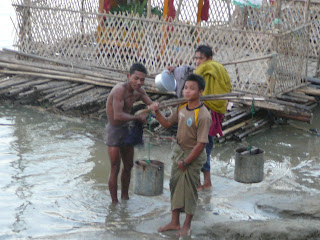
At 4pm, we stop at a small village called Ohn Ne Choung, and are free to wander round for an hour. There is no dock, and the ship merely pulls into the river bank and throws out a gang plank.

We cross it and climb the steep sandy bank to find the village. The houses are the usual two room affairs made of bamboo and rattan. Each has a large fenced area around it with either a pig, or an ox tethered in the yard, or the well to do have both, plus chickens. It’s a bit like having your car and dinner sitting in the garden. There are narrow lanes between the houses often lined with trees making it very picturesque. There are some wider roads to allow the ox and cart to travel through it. The ground is very fine dirt, almost sand like, and so everywhere is dusty. There are a few power lines and no running water or sewer pipes. All the water is taken from the river, which is filthy. There is a constant stream of people going down to the river to fetch water in two pails hanging from a bamboo pole strung across their neck.


Friday, June 19, 2009
Irrawaddy - Our Ship
We board a ship for a two night cruise down the Irrawaddy to Mandalay , the same journey that Rudyard Kipling made so famous in his poem, the Road to Mandalay . It is a wonderful feeling to be traveling in his footsteps and the ship we are on recreates the atmosphere perfectly.

We are traveling on the Pandaw 2, which is a copy of the original Pandaw , designed in 1948 expressly for travel on the Irrawaddy . It has a draft of only three and a half feet, and what is mind boggling about the original is that it was built in Scotland and actually sailed from there to Burma with this shallow draft. The ships have been redesigned for today’s traveler and are a wonderful mix of modern day comfort with colonial design. Al l the cabins and fixtures are made of teak, the furniture is rattan and there is an extensive sundeck with teak reclining chairs. Our cabin opens onto the deck and there are two rattan chairs outside our door for our private use.

There are only 24 cabins and the ship boasts a staff of 26. However on our cruise there are just 4 passengers including us, so we get over 6 staff each!

Navigating the Irrawaddy has always been extremely difficult, because of its perilous waterways. It is a shallow and extremely wide river, full of sandbanks. There are neither locks nor weirs to control the water level, as there are on other great rivers of the world. Nor are there charts, as the sands shift with such rapidity that they would be out of date before the ink was dry. Instead they rely on a pilot ship that goes in front and marks a safe channel with bamboo poles. But even this method is not perfect, as we discover on our first night. At one point we are sandwiched between two fast shifting sandbanks that cut off our passage. We have to turn round and find another route past them. Several times during our trip we have two crew members standing either side of the bow of the ship measuring the depth of the river with long bamboo poles. They continually call out the depth to the captain and at one point we were down to less than 5ft.

We are traveling on the Pandaw 2, which is a copy of the original Pandaw , designed in 1948 expressly for travel on the Irrawaddy . It has a draft of only three and a half feet, and what is mind boggling about the original is that it was built in Scotland and actually sailed from there to Burma with this shallow draft. The ships have been redesigned for today’s traveler and are a wonderful mix of modern day comfort with colonial design. Al l the cabins and fixtures are made of teak, the furniture is rattan and there is an extensive sundeck with teak reclining chairs. Our cabin opens onto the deck and there are two rattan chairs outside our door for our private use.

There are only 24 cabins and the ship boasts a staff of 26. However on our cruise there are just 4 passengers including us, so we get over 6 staff each!

Navigating the Irrawaddy has always been extremely difficult, because of its perilous waterways. It is a shallow and extremely wide river, full of sandbanks. There are neither locks nor weirs to control the water level, as there are on other great rivers of the world. Nor are there charts, as the sands shift with such rapidity that they would be out of date before the ink was dry. Instead they rely on a pilot ship that goes in front and marks a safe channel with bamboo poles. But even this method is not perfect, as we discover on our first night. At one point we are sandwiched between two fast shifting sandbanks that cut off our passage. We have to turn round and find another route past them. Several times during our trip we have two crew members standing either side of the bow of the ship measuring the depth of the river with long bamboo poles. They continually call out the depth to the captain and at one point we were down to less than 5ft.
Wednesday, April 15, 2009
Bagan and Our Guide
Our guide in Bagan immediately reminds us of Lawrence, but without the star quality. He is twenty two, tall and lean with a terrible complexion and very trendy black framed glasses. Like many of the young Myanmar men his shiny black hair has dyed brown highlights. He has on a baby blue sweater over a white shirt and dark longyi, which he wears slung very low over his hips. He carries a mobile phone in his hand, and hanging from it is a small, terminally cute, white and pink teddy bear with a heart emblazoned on its chest. The overall effect leads one to question his sexuality. When he walks, the question is answered by a delicate swaying of the hips. He flashes a 200 megawatt smile that transforms his acne scared face into a very attractive one. What he has been unable to do with his complexion, he has made up for with many trips to the dentist. His teeth sparkle and gleam in the sunlight. He introduces himself by his Myanmar name, which is, he acknowledges, too difficult for foreigners to pronounce, so he suggests we call him Soe. Well that gets us off to a good start, and from this point on we refer to him as a Boy named Sue. He is charming and far easier company than Lawrence, plus he is an intelligent and knowledgeable guide.

We spend the next two days touring Bagan. Until today, we have been unsure about how well Mynamar compares to our previous trip to Cambodia, Laos and Vietnam. Today, Myanmar comes into its own. Bagan is breathtaking; a large plain of around 42 square kilometers on the east bank of the Irrawaddy River, that is home to a few small villages and over 4000 temples and stuppas. Most of them were built between the 11th and 13th centuries, although the earliest date back to the 3rd century, and we see several from the 9th century.

It all came to an end with the Mongolian Invasion in 1287. Fortunately the Mongols were also Buddhists and left the Pagodas intact. At one point there were 5000 of them, but the ravages of time reduced that number considerably. Then a huge earthquake in 1975 damaged many more. Now there are around 4,000 but many are just piles of rubble. There are maybe 2,000 that are worth a visit. We only have two days, and manage to see about 15!

We spend the next two days touring Bagan. Until today, we have been unsure about how well Mynamar compares to our previous trip to Cambodia, Laos and Vietnam. Today, Myanmar comes into its own. Bagan is breathtaking; a large plain of around 42 square kilometers on the east bank of the Irrawaddy River, that is home to a few small villages and over 4000 temples and stuppas. Most of them were built between the 11th and 13th centuries, although the earliest date back to the 3rd century, and we see several from the 9th century.

It all came to an end with the Mongolian Invasion in 1287. Fortunately the Mongols were also Buddhists and left the Pagodas intact. At one point there were 5000 of them, but the ravages of time reduced that number considerably. Then a huge earthquake in 1975 damaged many more. Now there are around 4,000 but many are just piles of rubble. There are maybe 2,000 that are worth a visit. We only have two days, and manage to see about 15!
Subscribe to:
Posts (Atom)
