The next morning we go down for breakfast in our hotel, the Eurostars Zona Rosa Suites. It is a rather desultory affair, and each morning we hope it will get better, but it never does. It is a buffet with a few plates of fresh fruit cut into slices the previous evening, slices of cheese cut just after the fruit, individual packets of cereal, packaged sliced bread, thin slices of tinned ham, and some warming pans containing refried beans, rice and hotcakes. The hot food was obviously cooked many hours earlier and placed in the warming pans where it sits until 11.30 when it is cleared away.
This morning there is a table of three Mexicans who look a little scary. One of them must be at least 400 lbs and seems unable to sit upright, but instead slouches down at 45 degrees from the floor. We guess that sitting upright is impossible because his stomach would crush his legs. He is wearing a well worn track suit which hasn’t seen soap and water for some time. He hasn’t shaved for several days, and the last time he washed is when he had to take his track suit off to put it in the laundry. His two companions, while equally grubby are far less imposing and far smaller. We are wondering how they could afford to be staying in the hotel, when we notice that the two companions do everything for the large man. He just has to say that he wants more food and they jump up and get it for him. This obviously keeps them fit, as his calls for more are frequent. There is obviously some sort of hierarchy going on here that we know nothing of, but might explain how they can afford to stay in this hotel.
Showing posts with label local food. Show all posts
Showing posts with label local food. Show all posts
Wednesday, September 16, 2009


Wednesday, August 5, 2009
Tea With The Akha Tribe
Again we distribute cookies and medicine. We meet two young girls with red paint all over their face. It turns out these girls had been fascinated by the red lips of a previous tourist, and she had kindly given the girls her lipstick. They had not had an occasion to wear it since, as there had been no visitors for months. But now we had arrived, they thought it appropriate to put it on. One of the girls had obviously forgotten that it was supposed to go on the lips, and had instead made red dots all over her face. The older girl had remembered where it was to go, but her skills of application were limited. She had a huge red gash from ear to ear. However both young women thought they looked beautiful, and as men have learned all over the world, it is always wise to offer no opposition to these feelings that women have.

Here we are invited to have tea in one of the houses. We feel we cannot turn this down, but we would much rather not drink out of any of the rather dirty looking glasses we are offered. However our guide says that they do wash their utensils in the river water. We follow the example of our guide who pours tea into his glass, swills it round and then tips it out, before pouring in more which he drinks. We are also offered deep fried peanuts straight from the pan, which are delicious, together with some bananas collected from the jungle. We are pleasantly surprised to find that we do not get sick the next day.
When we return to Kyaingtong in the late afternoon, we are both exhausted and promptly fall asleep.
This is not a town famous for its restaurants. There are a few local eating places, none of them catering to tourists. However that evening we find a Chinese restaurant that deep fries a whole fish caught that day in the river. It costs $3 and is delicious.

Here we are invited to have tea in one of the houses. We feel we cannot turn this down, but we would much rather not drink out of any of the rather dirty looking glasses we are offered. However our guide says that they do wash their utensils in the river water. We follow the example of our guide who pours tea into his glass, swills it round and then tips it out, before pouring in more which he drinks. We are also offered deep fried peanuts straight from the pan, which are delicious, together with some bananas collected from the jungle. We are pleasantly surprised to find that we do not get sick the next day.
When we return to Kyaingtong in the late afternoon, we are both exhausted and promptly fall asleep.
This is not a town famous for its restaurants. There are a few local eating places, none of them catering to tourists. However that evening we find a Chinese restaurant that deep fries a whole fish caught that day in the river. It costs $3 and is delicious.
Wednesday, July 29, 2009
Enn - Tribe
The people of Banglu have very little food, other than rice and a few vegetables. They catch whatever they can in the surrounding jungle, which is usually limited to the occasional rat. They skin the rats and leave them hanging in their homes to dry. Two or three rats will feed the entire village when added to a thin vegetable soup with rice and chilies. We visit a home where there is a collection of small animal skulls and skeletons hanging from the ceiling, the purpose of which is not made clear. A small fire is burning in the middle of the floor and a cooking pot with soup simmers on top.

The smell is not pleasant. A rattan basket holds a large amount of cooked rice which sits there for days, and the people just take what they need for each meal. Home sweet home to them, but about as far away from it as we can imagine.
On the advice of our guide we went to the local market before we left Kyaingtong and bought a huge amount of cookies for the children and an assortment of basic medicines and shampoo for the people. Word spreads quickly that tourists have arrived in the village, and the children are gathered around us within minutes. They are all filthy but full of smiles which win our hearts.
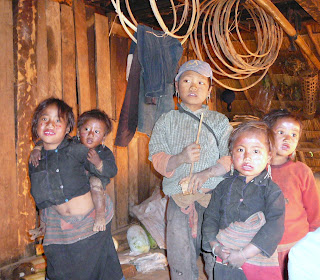
It is customary for these tribes people never to ask for anything, so although these children are hungry, have nothing, and know that we have treats that they would never normally get, they don’t beg. But when we produce the cookies they all get in a line to be given the treats, and thank us, as their turn comes for the cookies. If that doesn’t melt your heart, nothing will.
After that we all sit down in one of the huts, and the women who have health problems quietly line up to tell our guide what ails them. The guide dispenses the relevant medicine. Several of the women have diarrhea which is hardly surprising, but sadly we have not brought up any medicine for that. We are not too sure that the guide acting as a dispensing chemist is the answer to the tribe’s problems, but it is certainly better than nothing. They have not seen a tourist for three months and this is the only way they ever get medicine.

The smell is not pleasant. A rattan basket holds a large amount of cooked rice which sits there for days, and the people just take what they need for each meal. Home sweet home to them, but about as far away from it as we can imagine.
On the advice of our guide we went to the local market before we left Kyaingtong and bought a huge amount of cookies for the children and an assortment of basic medicines and shampoo for the people. Word spreads quickly that tourists have arrived in the village, and the children are gathered around us within minutes. They are all filthy but full of smiles which win our hearts.

It is customary for these tribes people never to ask for anything, so although these children are hungry, have nothing, and know that we have treats that they would never normally get, they don’t beg. But when we produce the cookies they all get in a line to be given the treats, and thank us, as their turn comes for the cookies. If that doesn’t melt your heart, nothing will.
After that we all sit down in one of the huts, and the women who have health problems quietly line up to tell our guide what ails them. The guide dispenses the relevant medicine. Several of the women have diarrhea which is hardly surprising, but sadly we have not brought up any medicine for that. We are not too sure that the guide acting as a dispensing chemist is the answer to the tribe’s problems, but it is certainly better than nothing. They have not seen a tourist for three months and this is the only way they ever get medicine.
Subscribe to:
Posts (Atom)
